Mia Roze Bootz Prestige Consulting

Thirty-plus years of senior work — now working for owners and operators, not employers.

This is the one place for everything Mia Roze Bootz does: consulting for healthcare operators and for events & hospitality owners, merchandising and licensing pitch packages under her Mia Rose Bootz brand, and her work as an author. Masters in Business, vice president roles in marketing and sales for national publicly traded companies, national marketing campaigns across radio and TV, and thirty-plus years in the industry.

Every inquiry is answered personally. Every engagement begins with a signed letter — no exceptions.

Painted illustration of a cowboy boot used as a vase — splashed in bold pink, teal, orange, red and gold — holding pink and red roses and greenery

Healthcare

The knowledge, without the chair.

Thirty-plus years in skilled nursing and skilled rehab — administrator, group-level oversight, national marketing and sales — sold as systems your own team runs. Revenue done legally, census recovery, company-wide calendars and menus, survey readiness, and recruiting for hard-to-fill chairs.

Events & Hospitality

Full rooms, the right people in the chairs, events that pay for themselves.

Placement for executive chefs, general managers, and hospitality leadership; full-service event planning priced as a share of the budget; event calendars built as revenue systems; and fractional marketing leadership for restaurants, clubs, estates, venues, and wineries.

Merchandising & Licensing

Mia Rose Bootz — Marketing and Sales Fashionista

Product development and merchandising design built on an archive of around 6,000 original design pieces and thousands of photographs — turned into licensing pitch packages for television fashion and lifestyle lines, plus two standalone app concepts. Around ten years in and around the oil field sits behind the Landman package in particular.

~6,000original design pieces in the archive
Thousandsof photographs in the archive
9completed pitch packages — 7 series decks, 2 app concepts
30+ yearsin marketing, sales, and the industry

Art & Paintings

Mia Roze Bootz — Artist & Decorative Designer

Original paintings, hand-painted murals, hand-decorated pieces, and one-of-a-kind designs across canvas, walls, fences, doors, home décor, apparel, luggage, and a signature pet line — every piece an original, no two alike. Her painted garden blocks say it best: butterflies, suns, flowers, and spirals in hot pink, teal, orange, and red. She is the color girl, and the work proves it.

Grid of Mia Roze Bootz's hand-painted garden blocks — butterflies, spirals, stars, a lemon slice, and a heart in bright pink, teal, orange, and rainbow colours
Painted garden blocks by Mia Roze Bootz — butterflies, spirals, and stars, each block its own painting.

The Book

A memoir — available to read free now

Book cover of Hello Dad, Are You There? The Silence Is Deafening by Melissa Lee Whitney Rice — the title in bold red lettering above the author's colourful original artwork of a singer with a pink microphone, palm trees, and a light-bulb brain; published by Mia Roze Bootz Novellas

Hello Dad, Are You There? / The Silence Is Deafening

The memoir by Melissa Lee Whitney Rice (2026) — published under her author name. The site brand name, Mia Roze Bootz, is her business name.

Read it free now on the Internet Archive. Kindle and paperback editions are coming to Amazon — Kindle eBook $4.99 · Paperback $14.99.

Read it free on the Internet Archive

Contact

One address reaches every part of the practice:

Mia Roze Bootz's hand-painted mailbox — a smiling rainbow sun on the door, multicolour rays streaking across the top, and an XOXO border along the bottom

HOLD THE LINE

Stand Your Bootz on the Ground.

We’re here to help them.

You are not required to answer the door when law enforcement knocks.

Officers cannot enter your home without a warrant signed by a judge — an administrative warrant is not enough.

You have the right to remain silent.

When the Badge Breaks the Law

FBI agents and officers arrested and convicted — documented cases, adjudicated in court — on a page of its own now, set wide enough to read.

Charles McGonigal, the FBI’s former New York counterintelligence chief — 78 months in two cases. Babak Broumand — 72 months for bribes. Felix Cisneros Jr. — 121 months, affirmed on appeal. Baltimore’s Gun Trace Task Force — all eight officers convicted, 7 to 25 years. And former FBI Director James Comey, charged in three separate federal cases — convicted of nothing; each case’s status stated plain.

Surveillance

Your phone, your movements, your camera — what the courts have actually held — on a page of its own now, set wide enough to read.

The warrant rule for your phone’s location history under Carpenter; geofence warrants after Chatrie and the Fifth Circuit’s Smith; Stingrays and the flag on the only rule that governs them; license-plate readers and Texas’s missing ALPR law; and your right to record police. The page also carries Misuse — the Texas plate-reader cases, in a few bullets each — and the numbers, with the finding underneath them: no agency keeps an official count.

Gun Rights

Amendment Two in its own words — the right, the purchase, the Texas rules — on a page of its own now, set wide enough to read.

The amendment’s own text, word for word; what the Supreme Court has held in Heller and Bruen; how to buy a gun legally — the licensed dealer, Form 4473, the NICS check, the federal age floors; Texas permitless carry under HB 1927; and the questions that are not settled, shown on both sides: the under-21 handgun rule after Reese v. ATF and the September 2026 DOJ position, and 18-to-20 carry after Andrews v. McCraw.

The Patriot Act

What it is, its best-known provisions, and what has lapsed — on a page of its own now, set wide enough to read.

The Uniting and Strengthening America by Providing Appropriate Tools Required to Intercept and Obstruct Terrorism Act of 2001 — signed October 26, 2001. Section 215 business records, the authority behind the bulk telephone-metadata program; Section 206 roving wiretaps; Section 213 delayed-notice “sneak and peek” warrants. And the status, stated plain: §215, §206, and the “lone wolf” provision lapsed on March 15, 2020 and have not been reauthorized — while most of the Act remains in force.

Castle Doctrine — Texas

Texas Penal Code §§ 9.31–9.32 and 9.41–9.43 — your home, your vehicle, your workplace — on a page of its own now, set wide enough to read.

Self-defense under § 9.31; deadly force in defense of a person under § 9.32(a); and the § 9.32(b) presumption — your belief that deadly force was immediately necessary is presumed reasonable when an intruder unlawfully and with force entered, or was attempting to enter, your occupied habitation, vehicle, or place of business or employment. Then §§ 9.41–9.43 — defense of your own property, the narrow deadly-force rule for property, and protecting a third person’s property.

Stand Your Ground — Texas

No duty to retreat — Texas Penal Code §§ 9.31(e)–(f) and 9.32(c)–(d) — on a page of its own now, set wide enough to read.

A person who has a right to be present where the force is used, who has not provoked the other person, and who is not engaged in criminal activity is not required to retreat before using force — or deadly force. And the fact-finder may not consider any failure to retreat when judging whether the belief that the force was immediately necessary was reasonable.

Mortgage Fraud

The statutes, plain — and the skimming: the loan is the prize, not the house — on a page of its own now, set wide enough to read.

18 U.S.C. § 1014 and 18 U.S.C. § 1344 — each carrying up to 30 years — and Texas Penal Code § 32.32. Then the skimming: 12 U.S.C. § 1709-2, its elements, its penalty, its one-dwelling exemption, and its scope limit; U.S. v. Gaudin; the FBI’s documented mechanics and its two categories; and Texas law.

RICO

The federal racketeering law — 18 U.S.C. §§ 1961–1968 — and the private right to sue for treble damages — on a page of its own now, set wide enough to read.

An enterprise; a pattern of racketeering activity — predicate acts including the trafficking offenses under §§ 1589–1591 and mail and wire fraud; the criminal penalties under § 1963; and the civil action under § 1964(c) — threefold (treble) damages, costs, and attorney’s fees for a person injured in their business or property.

Human Trafficking Laws

Federal trafficking statutes — and a presidential emergency order aimed at the people who profit — on a page of its own now, set wide enough to read.

You don’t have to be silent. 18 U.S.C. § 1589 — forced labor. § 1590 — trafficking for peonage, slavery, involuntary servitude, or forced labor. § 1591 — sex trafficking of children, or by force, fraud, or coercion. § 1595 — the civil remedy: a victim may sue. And Executive Order 13818 — a declared national emergency, and the blocking of the property of the people responsible. The page also carries how to report human trafficking in Texas.

For more information, check the Pages.

The facts on this section were drawn from a verified research file built on U.S. Department of Justice press releases, federal court opinions, the official Texas statutes site, and the sources named in each panel (October 31, 2026) — including its flags, which are printed here rather than smoothed over. This section is general information, not legal advice.

This is the end of the line.

Mia Roze Bootz Prestige Consulting — Healthcare

The knowledge, without the chair.

Thirty-plus years in skilled nursing and skilled rehab — administrator, group-level oversight, national marketing and sales — sold as systems your own team runs. No executive-director seat, no signature on anyone's license, no survey liability carried by the consultant. You get the eye; your licensed staff keeps the chair.

What operators hire this for

Revenue, done legally

  • Medicare skilled-rehab revenue review: rehab and case-mix capture, documentation, length of stay — getting the most money in the building legally.
  • Census recovery: inquiry → tour → move-in systems that stop good inquiries leaking away.

Systems built once, run everywhere

  • Company-wide activity calendar — one monthly calendar built at home-office level, engineered to each building's budget and census, with supply lists (or bulk-bought supply packages shipped per building). Homes write in their own additions. Standing spec: bingo always Wednesdays at 2:00 in every home; one Friday before Thanksgiving reserved for families; staff get 3 days after Halloween to get Christmas trees up for Thanksgiving; every holiday and food-related national day gets a matching activity.
  • Menus re-engineered to the 2025–2030 Dietary Guidelines — the inverted pyramid released January 7, 2026. The federal SNF rule (42 CFR 483.60) ties menus to "established national nutrition guidelines," so the compliance target moved when the guidelines flipped. Menus rebuilt once, costed per building.
  • The back-office stack — billing cycles, census reports, calendars, menus, marketing mailings, survey-prep binders, done one consistent way across buildings instead of twelve habits.

Readiness

  • Quality-assurance reviews and mock survey prep.
  • Mass evacuation planning and execution, safety planning — lived experience, not theory.

People

  • Recruiting and placement for hard-to-fill chairs: administrators, department heads, dining and activities leadership, sales and marketing.
  • Department-head training built from hands-on administrator-in-training rotation through every department.

Who this fits

Skilled nursing and skilled rehab operators, hospitals, the medical field, assisted living, continuing care communities, and senior living — single buildings that need one fix, and groups that need one system across many buildings. Assisted living touched at group level is in scope as part of a group engagement; this practice does not take a standalone building's licensed chair.

Rate card

  • Consulting: $200–$350/hour · ~$1,600–$2,500/day
  • Retainer: $5,000–$12,000/month
  • Defined projects (calendar system, menu rebuild, census recovery): $10,000–$25,000
  • Placement: 20% of first-year salary, contingency · 25–30% retained/executive

How an engagement works — and how it's protected

  1. Everything in writing before work starts: scope, deliverables, fee, and timeline in one signed engagement letter. No handshake deals.
  2. The consultant advises and builds; the operator decides and implements. Clinical and licensing decisions stay with the operator's licensed staff — the consultant never holds the chair and never signs for the building.
  3. Placement terms (when recruiting is part of the work): the fee is earned when the placed candidate starts. If the hire leaves inside the 90-day guarantee window, the remedy is a replacement search at no additional fee — not a refund. The guarantee does not apply if the client changes the role, cuts pay or hours, lays the person off, or withheld material facts about the job. The client makes the final hiring decision and runs its own background checks and credential verification. Liability is capped at fees paid under the engagement.

Contact

Mia Roze Bootz Prestige Consulting

Email:

Every inquiry is answered personally. Every engagement begins with a signed letter — no exceptions.

Mia Roze Bootz Prestige Consulting — Events & Hospitality

Full rooms, the right people in the chairs, events that pay for themselves.

Thirty-plus years of marketing, sales, and experience design — national campaigns, radio and TV, venues filled on purpose — now working for owners, not employers.

What owners hire this for

Placement — the right person in the hard chair

  • Executive chefs and culinary leadership for high-end restaurants, private clubs, hotels, and estates. (Club and estate chefs run $110,000–$200,000+; one correct hire is worth getting right.)
  • General managers, hospitality and tasting-room managers, wine club managers, events directors, estate and household leadership.
  • Marketing and sales leadership for venues, clubs, and hospitality groups.

Events that make money

  • Full-service event planning and design, priced at 15–20% of the total event budget.
  • Event calendars built as revenue systems — a season of events designed to fill rooms, sell memberships and wine clubs, and bring guests back — not one-off parties.
  • Grand openings, launches, and re-openings: the whole push, from the list to the night itself.

Marketing & experience consulting

  • Fractional marketing leadership: campaigns, public relations, and sales systems for restaurants, clubs, estates, venues, and wineries — without hiring a full-time VP.
  • Guest-experience design: how a place looks, feels, and runs from the first photo a guest sees to the walk out the door.
  • Winery hospitality — staffing, events, wine club growth and marketing, and the operations of showing guests the place: the fields, the machinery, the making of it. Experience and people, not the palate side.

Openings and turnarounds

  • New venue or concept openings: staffing plan, marketing launch, first-season calendar.
  • Quiet turnarounds for good places with empty seats: offer, pricing, calendar, and team fixed as one job.

Who this fits

Independent owners and small groups: high-end restaurants and chef-led kitchens, private clubs, private estates and families, event venues and caterers, boutique hotels, and wineries. People who need the senior brain for a season or a project — not another full-time executive on payroll.

Rate card

  • Placement: 20% of first-year salary, contingency · 25–30% retained/executive. On a $120,000 placement: $24,000–$36,000.
  • Consulting: $200–$350/hour · retainers $5,000–$12,000/month · projects $10,000–$25,000
  • Events: 15–20% of total event budget (nonprofit 10–15%)

Placement terms — finalized before any search starts

  1. One signed engagement letter before work begins: role, fee, guarantee, and terms agreed by both parties in writing. Nothing starts on a handshake.
  2. The fee is earned when the placed candidate starts work. It is a fee for the search, presentation, and placement — not a payment held against how any human being performs forever.
  3. The remedy for an early departure is replacement, not refund. If the hire leaves or is let go for cause inside the 90-day guarantee window, Prestige runs a replacement search for the same role at no additional placement fee. Fees already paid are not refunded.
  4. The guarantee does not apply if the client changes the role, duties, pay, or hours; lays the person off or eliminates the position; creates the conditions that drove them out; or withheld material facts about the job, the business, or the workplace during the search.
  5. The client hires. The client makes the final hiring decision and runs its own interviews, references, background checks, and credential verification. Prestige presents and vets candidates; Prestige does not guarantee any individual's future performance or conduct.
  6. Liability is capped at the fees paid under the engagement; no consequential or open-ended damages.

Contact

Mia Roze Bootz Prestige Consulting

Email:

Every inquiry is answered personally. Every engagement begins with a signed letter — no exceptions.

Euphoria

Where There Is Smoke There’s Fire

“Euphoria will be a building you float through.”

Euphoria is for states where weed is legal. Guests float among the rooms — no reservations, with one exception: The Devil’s Lettuce, the tasting room, where reservations are required.

Poster illustration of Euphoria — adult guests floating full-body among the restaurant's rooms on drifting platforms, with robot servers and people bringing orders, and wisps of smoke curling through the air
Euphoria — a building you float through. The whole house at once — the larger, full-size build.
Front-of-house design illustration of Euphoria — the dark facade lit by sunset flames in orange, pink, teal and gold glowing like stained glass, with a warm lit doorway and glowing windows; no people
The front of the house — sunset flames and a warm lit doorway. A front that also suits a smaller build.
Illustration of Euphoria — guests at tables on floating platforms drifting between lush green rooms lit by warm ember lamps, with a cocktail bar and a dessert counter, and wisps of smoke curling through the air
The first Euphoria sketch — from the first builds: guests drifting on floating platforms between lush green rooms, the cocktail bar and the dessert counter. The concept the whole house grew from.

How Euphoria Works

You Float Through

Guests float among the rooms. No reservations — with one exception: The Devil’s Lettuce, the tasting room.

AI, Built In From the Start

VR/3D headsets at the tables. Guests build and customize their order on a tablet — AI built in, The Star System runs the house — and the order is brought out by robot servers and people.

Build-Your-Own Everything

The house philosophy: build-your-own everything. At each station, the Chef’s Kiss is the chef’s-choice offering. And not everything is infused — infused or straight is the guest’s choice, everywhere it applies.

The Spaces

Every space is shown in more than one concept — the same room at different scales, so a build can suit the size of space you have: a smaller space, or a larger, full-size one. Each caption says which scale the concept suits.

01

The Devil’s Lettuce

The Tasting Room

Reservations Required

Farm-to-table. The one room you don’t float through.

Poster illustration of The Devil's Lettuce, the Euphoria tasting room — guests and a robot server at a long farm table set for an infused tasting menu
The Devil’s Lettuce — the tasting room: the long farm table. Scaled for a larger dining room.
Poster illustration of The Devil's Lettuce — velvet armchairs in purple, teal, pink and gold around small round tables for four, a glass wall at sunset, a stone fireplace, colored chandeliers, and Penny the robot server carrying a tray; no people
The Devil’s Lettuce — another concept: velvet armchairs at tables for four. Scaled for a smaller, intimate room.

Infused tasting menus:

  • Crafted infused beverages
  • Specialty and infused butters
  • Infused salad dressings
  • Infused desserts
02

The Munchiez

Cocktails & Bar Food

The cocktail space, with bar food.

Poster illustration of The Munchiez — Euphoria's cocktail and bar-food space
The Munchiez — cocktails and bar food. The full-room concept, scaled for a larger space.
Poster illustration of The Munchiez bar — Bart the copper robot bartender shaking a cocktail behind the bar, velvet bar chairs in teal, gold, pink and green, and cowboy boots and roses on the shelves; no people
The Munchiez — another concept: Bart behind the bar. The bar on its own, scaled for a smaller space. In a smaller build like this one, the karaoke could live here in the Munchiez bar; in the full-size house, karaoke’s home is Bling & Burn.
  • Build-your-own burgers
  • Hot dogs
  • Fried chicken and sides
  • Mozzarella sticks — big fat chunks
  • Potato skins
  • Tacos
03

Cupcakez

Desserts & Drinks

Desserts and drinks.

Poster illustration of Cupcakez — Euphoria's dessert and drinks room, with cupcakes, milkshakes, and liquid-nitrogen ice cream
Cupcakez — sweet, cold, and made your way. Scaled for a larger room.
Poster illustration of Cupcakez — a glowing bakery case of cupcakes, muffins, pies and croissants, with a copper robot baker in a tall hat at the case and a second robot scooping ice cream beside it; no people
Cupcakez — another concept: the bakery case, front and center. Scaled for a smaller space.
  • Liquid-nitrogen ice cream
  • Build-your-own pie flight
  • Build-your-own cupcake tasting
  • Milkshakes — infused or not
  • Delectable treats
  • Crafted cocktails
04

Daisiez

The Patio

The patio — for smoking and drinking.

Poster illustration of Daisiez — Euphoria's open-air patio for smoking and drinking, outside under the lights
Daisiez — the open-air pause between rooms. Scaled for a smaller patio.
Poster illustration of the patio — swing benches and sofas around a fire pit, cornhole, ring toss and giant dice on the deck, string lights overhead, and small flying robot servers carrying trays; no people
Daisiez — another concept: swings and a fire pit under the lights. Scaled for a larger, full-size patio.
05

Sparkles

The Merchandise Shop

Retail & To-Go

The merchandise shop — everything Euphoria you can wear and take home.

Poster illustration of Sparkles — Euphoria's merchandise shop, with the potkery bakery and shelves of merchandise
Sparkles — retail & to-go, and the potkery. Scaled for a full-size shop.
Poster illustration of Sparkles — a copper robot baker holding a tray of croissants and tarts beside a stone fireplace oven, shelves of folded sweatshirts and take-home boxes, and a glass case of bracelets and charms; no people
Sparkles — another concept: the shop and its fireplace oven. Scaled for a smaller space.
Poster illustration of Sparkles — a real merchandise shop glittering with sparkle, with shelves, folded stacks and display tables of colorful printed t-shirts and sweatshirts showing copper robot crew faces and names, the Euphoria wordmark and funny weed sayings, a BAKE MY DAY tee for Cookie the baker and a yellow DEVILS LET US tee hung on the wall with a big piece of lettuce displayed under it, a folded BURNT BISCUITS tee with Blaze on the table, bright bandana dresses and men's Hawaiian shirts with house prints, and a sparkling glass case of bracelets and charms; no people
Sparkles — another concept: the merchandise shop floor. Scaled for a larger, full-size shop floor.

The Potkery

The in-restaurant bakery is the potkery — Mia’s coinage — carrying Mia Roze’s Blissful Endings Treatz.

06

Sprinklez

The Ice Cream Shop

The ice cream shop — its own space, separate from Cupcakez. Nitro works the counter.

Poster illustration of Sprinklez — Euphoria's ice cream shop: Nitro the copper robot at the parlor counter scooping liquid-nitrogen ice cream in clouds of vapor, with rows of scoops, cones and sundae glasses along the counter; no people
Sprinklez — the ice cream shop, as designed: Nitro at the counter, in a space of its own.
  • Liquid-nitrogen ice cream, frozen on the spot
  • Scoops, cones and sundaes
  • Pick-your-own pie flights
  • Build-your-own cupcake tastings
07

Bling & Burn

The Little Seating Lounge

The little seating lounge — headsets, music and little concerts.

Poster illustration of Bling & Burn — Euphoria's seating lounge: a copper robot relaxing in a comfy recliner chair wearing headphones, VR headsets on stands on the table, cushioned seating and rows of chairs facing a small karaoke stage whose wall is hung with colorful painted calavera masks, with cowboy boots and roses around the stage; no people
Bling & Burn — the lounge. Scaled for a larger space.
Poster illustration of Bling & Burn — another concept: two plush recliner chairs with VR headsets and headphones on stands, facing a small karaoke stage with a vintage microphone, its wall hung with colorful painted calavera masks and cowboy boots, with roses garlanded around the stage; no people
Bling & Burn — another concept: the karaoke stage up close. Scaled for a smaller space.
08

Herbz & Fiddles

The Little Farm

The little farm, out in the fields — the fields behind the farm-to-table kitchen.

Poster illustration of Herbz & Fiddles — Euphoria's outdoor farm: garden rows of vegetables, a stone herb spiral and fiddlehead ferns, a greenhouse and a farm stand, with a copper robot gardener carrying a basket of fresh-picked vegetables; no people
Herbz & Fiddles — the little farm, out in the fields.
  • The farm behind the farm-to-table kitchen at The Devil’s Lettuce
  • Baskets picked fresh for the house

The Star Fleet — The Crew, Run by The Star System

Euphoria’s AI has a name: The Star System — the house’s own built-in AI, running the tablets, the ordering, and the crew. And the crew the system calls on is The Star Fleet — Euphoria’s robot crew, under The Star System: The Tablets · The Waitresses · Bart · Buddy · The Chef · Belle — cleaning · Torque — maintenance.

Poster illustration of The Star Fleet crew together — the copper robots in their name t-shirts under the string lights: Penny, Bart, Buddy, Blaze the chef in his tall white hat, Cookie, Nitro, Belle, Torque, Sizzle, Candy and Whippy, with Serenity the car, The Stardust Shuttle and the Pop-Up Fleet trucks behind them
The Star Fleet crew — the whole crew together, with the fleet behind them.
THE STAR SYSTEM · AT EVERY TABLE

The Tablets

“Your order, built by you — at your table.”

Poster illustration of The Tablets — guests at wooden tables building their orders on glowing table tablets, VR headsets beside the tablets, while a copper robot server floats in with drinks
The Tablets — the order starts at your table.
  • Table tablets at every table — guests build and customize their own orders.
  • AI built in — the tablets run on The Star System, Euphoria’s own AI.
  • VR / 3D headsets at the tables, right alongside.
  • The crew the system calls on is The Star Fleet — Euphoria’s robot crew, under The Star System.
  • Infused or straight — the tablet builds it your way.
THE STAR FLEET · THE FLOOR

Meet Penny — The Waitresses

“Penny — robot servers, working alongside people.”

Poster illustration of Penny, The Waitresses — three copper robot servers in aprons floating with trays of food and drinks, working alongside two human servers carrying trays of their own
Penny & the waitresses — robots & people, one crew. Scaled for a larger room.
Poster illustration of Penny, The Waitresses — three cute copper robot servers in flowing tie-dye hippie dresses and flower crowns, floating with trays of food and drinks above candlelit tables; no people
Penny — the waitresses in flower crowns, beads and fringe. Scaled for a smaller, intimate room.
  • Penny brings the orders out — straight from the kitchen to your table.
  • They work alongside people, never instead of the welcome.
  • Guided by The Star System, so every order finds its table.

Penny brings it out — robots & people, one crew, and the order you built on the tablet arrives with a smile, copper or human.

THE STAR FLEET · THE BAR

Meet Bart

“The robot bartender — his name is what he does.”

Poster illustration of Bart — a copper robot bartender in a bow tie shaking a cocktail behind the bar, with guests laughing on either side and bottles and glasses along the counter
Meet Bart — the robot bartender, with a full house at the bar. Scaled for a larger bar.
Poster illustration of Bart — the copper robot bartender alone behind his bar, shaking a cocktail, with labeled bottles and jars of lemons and oranges on the shelves and green velvet stools along the counter; no people
Bart — another concept: Bart alone behind his bar. The bar on its own, scaled for a smaller space.
  • Bart tends the bar — shaking, stirring and pouring.
  • Drinks built your way, infused or straight.
  • Powered by The Star System — he remembers how the house runs.

Bart, behind the bar — say hello; he’s part of the crew.

THE STAR FLEET · THE KITCHEN

Blaze — the chef

“The robot chef of the Euphoria kitchen.”

Poster illustration of The Chef — a copper robot chef in a tall white hat and apron, tossing a flaming pan over the stove with one hand and plating a dish with the other, surrounded by copper pots and fresh vegetables
The Chef — in this kitchen, the fire has a chef.
  • A robot chef runs the kitchen — fire, timing and plating.
  • The Chef’s Kiss lives here: chef’s choice at each station.
  • Every tablet order, cooked as built — The Star System keeps the line moving.

Where there is smoke, there’s fire — and in this kitchen, the fire has a chef.

THE STAR FLEET · AFTER HOURS

Meet Belle — The Glamour Squad & The Domestic Goddesses

“Belle — the cleaner — of The Glamour Squad, the Domestic Goddesses.”

Poster illustration of Belle — the cleaner, of The Glamour Squad, the Domestic Goddesses: three copper cleaning robots at work after hours: one polishing a table until it sparkles, one sweeping the floor, and one carrying a bucket of supplies, with floating islands in the clouds beyond the lanterns
Belle — the cleaner of The Glamour Squad, the Domestic Goddesses: sparkle is a job too.
  • Belle, the cleaner of The Glamour Squad, the Domestic Goddesses, keeps every room sparkling.
  • Tables polished, floors swept, the house reset for the next guests.
  • Quietly at work, guided by The Star System.

Belle — of The Glamour Squad, the Domestic Goddesses: sparkle is a job too — the crew nobody sees, and everybody notices.

THE STAR FLEET · BEHIND THE SCENES

Torque — maintenance

“Torque — the robot who keeps Euphoria running.”

Poster illustration of Torque — maintenance, a copper robot with a tool belt full of wrenches and pliers, turning a wrench on a great brass-and-glass machine of gears and glowing pipes
Torque — maintenance, the fixer of the house.
  • Torque, the maintenance robot, keeps the restaurant’s equipment running.
  • Gears, pipes and machines — checked, fixed and kept humming.
  • So the kitchen fires, the tablets glow and the crew keeps floating.

The fixer of the house — when something stops, Torque starts.

THE STAR FLEET · THE BUD SHOP

Meet Buddy

“Buddy — your budtender, at Voodoo.”

Poster illustration of Buddy, a full-body copper robot budtender in a green apron with his name on it, behind the wooden counter at Voodoo under a big hanging wooden sign reading VOODOO, with glass jars, pre-roll tubes and party supply gift bags; no people
Buddy — at the counter in Voodoo, his own shop.
  • Buddy works the counter at Voodoo, his own shop — where you get your pre-rolls and your party supplies.
  • Guided by The Star System, like the rest of the crew.

Buddy, at Voodoo — pre-rolls and party supplies; Buddy has you covered.

The Vehicles — Two Fleets, One Rolling Family

Euphoria rolls, too. The Ride Home is the house fleet — Serenity and The Stardust Shuttle, standing by to bring guests home. Our Pop-Up Fleet is its own thing, separate from the ride home: the food trucks, out on the road. Two fleets, different jobs, one rolling family.

THE RIDE HOME · THE HOUSE FLEET

Serenity & The Stardust Shuttle

“Peace of mind while you peace your mind.”

Poster illustration of The Ride Home — The Stardust Shuttle, a star-painted party bus, and Serenity, a matching star-painted car with peace signs, floating on clouds in front of the house at night
The Ride Home — Serenity the car and The Stardust Shuttle, standing by at the house.
  • Serenity — the house car. The Stardust Shuttle — the party bus.
  • Hippie style in darker colors — big stars and peace signs on both.
  • They take people home if they need it — nobody is left stranded after a night at Euphoria. The house takes care of its guests — first float to last ride.

“Peace of mind while you peace your mind.”

OUR POP-UP FLEET · ON THE ROAD

Our Pop-Up Fleet

“Where’s my party people.”

Poster illustration of Our Pop-Up Fleet — the three Euphoria food trucks lined up together with their serving windows open: Tasty Buds, the Treatz Truck and Whippies
Our Pop-Up Fleet — Tasty Buds, the Treatz Truck and Whippies, lined up together.
  • Three trucks, one fleet: Tasty Buds · The Treatz Truck · Whippies.
  • The party on the go — see our trucks on the go around your cities, depending on regulations.
OUR POP-UP FLEET · TASTY BUDS

Tasty Buds

“The infused-foods truck — Sizzle works the line.”

Poster illustration of Tasty Buds — the teal Euphoria food truck at night, with Sizzle the robot in a SIZZLE shirt serving trays of food at the open window and WHERE'S MY PARTY PEOPLE painted along the side
Tasty Buds — the infused-foods truck, Sizzle on the line.
  • Build-your-own burgers and build-your-own hot dogs.
  • Plus mozzarella sticks, potato skins and fried sides.
OUR POP-UP FLEET · THE TREATZ TRUCK

The Treatz Truck

“Mia’s Treatz on wheels — Candy works the dessert case.”

Poster illustration of the Treatz Truck — the purple Euphoria dessert truck at night, with Candy the robot holding a tray of cupcakes at the dessert case and WHERE'S MY PARTY PEOPLE painted along the side
The Treatz Truck — Mia’s Treatz on wheels, Candy at the case.
  • Mia’s Delightfully High Baked Treatz — the baked treats collection, on wheels.
  • Heavenly desserts from the case.
OUR POP-UP FLEET · WHIPPIES

Whippies

“The beverage truck — Whippy pours.”

Poster illustration of Whippies — the blue Euphoria beverage truck at night, painted with a teapot, tall iced drinks and cans, with Whippy the robot pouring coffee at the window and WHERE'S MY PARTY PEOPLE painted along the side
Whippies — coffees, teas and sodas, poured fresh.
  • Coffees and teas, poured fresh · sodas and canned beverages, cold.
  • Highly Whipped — Whippies’ own line, poured fresh at the truck.
Poster illustration of All Our Vehicles — the whole rolling family in front of the house at night: Serenity the car, The Stardust Shuttle bus, and the three Pop-Up Fleet trucks — Tasty Buds, the Treatz Truck and Whippies
All Our Vehicles — the whole rolling family: Serenity · The Stardust Shuttle · Tasty Buds · The Treatz Truck · Whippies. “Peace of mind while you peace your mind.”

Catering & Parties

Catering is available — Euphoria comes to your party, not just the other way around.

  • Parties & events: bachelor & bachelorette parties, birthday parties, party packages and weddings.
  • The Frosting — for your home party: Euphoria brings The Frosting to your home party.
  • The Pop-Up Fleet is the party on the go — Tasty Buds, the Treatz Truck and Whippies bring the catering to you.

Merchandising & Licensing

Poster illustration of Sparkles — the merchandise shop with garments and goods on display: printed t-shirts and sweatshirts on shelves, folded stacks and display tables, bandana dresses, Hawaiian shirts, the yellow DEVILS LET US tee with a big piece of lettuce displayed under it, and a glass case of bracelets and charms
Sparkles — the merchandise shop, goods on display.
Poster illustration of the Sparkles replica display — its own display world, not the clothing shop: the five mini replica vehicles lined up on tiered wooden shelves under spotlights against a deep teal starry-night backdrop, over a glass case with a miniature cobblestone road — Serenity the car, The Stardust Shuttle bus, and the Tasty Buds, Treatz Truck and Whippies trucks
Sparkles — the replica fleet on its own display shelves.
Poster illustration of the merchandise shop — the robot crew wearing their name t-shirts and sweatshirts, with folded shirts and sweatshirts stacked on the counters
Sparkles — the merchandise on display.
Poster illustration of Sparkles — shelves of folded sweatshirts, garments on hangers, take-home boxes, and a glass case of bracelets and charms beside the fireplace oven
Sparkles — shelves and goods on display.

Legal take-home items only.

Licensing

The Star Fleet crew, The Star System and the room names are original concepts of Mia Roze Bootz.

“Licensed from my ideas — don’t be stealing it.”

Licensing inquiries:

© Mia Roze Bootz — All licensing rights reserved.

Investors & Sponsors

Euphoria is a concept by Mia Roze Bootz, looking for the people who will build it. It is presented here in a range of concepts scaled to different sizes of space — a build can suit a smaller space or a larger, full-size one.

Investors and sponsors are invited to get in touch. Licensing inquiries are welcome too.

For more information, contact us:

© Mia Roze Bootz — All licensing rights reserved.

Contact

Mia Roze Bootz Prestige Consulting

Email:

Every inquiry is answered personally. Every engagement begins with a signed letter — no exceptions.

Cloudy Dayz Recovery Centers

Cloudy Dayz

“We’re here to put the sunshine back into your life”

“Turn your hopelessness into hopefulness.”

Cloudy Dayz is Mia Roze Bootz’s model for nationwide alcohol and drug recovery centers. This page presents her model as she sets it out — what the centers include — and the research topics the centers would study, labeled as research topics.

Poster illustration of a Cloudy Dayz center — a big two-story house with a wraparound porch and a swimming pool in flower gardens, golden sun rays breaking through the clouds overhead, and a mixed group of five people of different ages and backgrounds waving together from the porch
Cloudy Dayz — sunshine breaking through the clouds.
Painted illustration of a Cloudy Dayz center — a welcoming house with a wide porch in green gardens, grey clouds breaking apart overhead as golden sun rays pour through, people walking the garden path, one person painting at an easel, and another playing guitar on the lawn
The first Cloudy Dayz sketch — from the first builds: the smaller house, painting at an easel and guitar on the lawn, sunshine breaking through the clouds.
Painted illustration of a Cloudy Dayz center — a large two-story house with a wide columned porch in green gardens, a blue swimming pool beside the house, grey clouds breaking apart overhead as golden sun rays pour through, and people sitting together under a leafy tree
An early painted concept — the big house and the pool, people sitting together under the tree. The same center, at a larger scale.

The Model — What the Centers Include

Classes & Counseling

  • Classes
  • Counseling

In the Model

  • Homeopathic remedies
  • Music therapy
  • Reiki
  • Massage
  • Acupuncture

Exercise & Hobbies

  • Exercise, including walking
  • Hiking
  • Photography
  • Painting
  • Baking
Poster illustration of the Cloudy Dayz model — a balanced, mixed group in a sunny plant-filled room: a young man baking muffins at a counter, a woman painting at an easel, an older woman stretching by the window, and a man receiving a shoulder massage
The Model — learning, talking, moving, and making things again.

PART OF THE MODEL — IN MIA’S WORDS

“A way to sleep through drug withdrawal.”

Poster illustration for In Her Words — an adult sleeping peacefully
Her words, kept exactly as she said them.

Getting On Your Feet

  • Assistance
  • Résumé building
  • Job hunting
  • Clothing

Aftercare

Aftercare is included in the model.

Poster illustration of Getting Back on Your Feet — two people shaking hands beside a desk with a laptop and résumés and a rack of clothing, sunlight streaming through the window
Getting back on your feet — recovery does not end at the door.

Research Topics

Topics the centers would study — each one a research topic.

RESEARCH TOPIC

LSD & Psychedelic-Assisted Therapy

LSD and psychedelic-assisted therapy research — a topic for study at the centers.

RESEARCH TOPIC

Marijuana in Sobriety

Marijuana in sobriety — a topic for study at the centers.

RESEARCH TOPIC

“This Frog Stuff”

The kambo / bufo family — a topic for study at the centers.

These are research topics only.

Poster illustration of the Cloudy Dayz research topics — questions on the desk: notes and reading for the topics the centers would study
Questions for research — topics for study, not treatments.

The Merch Line

Cloudy Dayz carries its own merch line:

  • Graphic tees
  • Sweatshirts
  • Bracelets
  • Charms
  • The “Rehab Is for Quitters” tee
Poster illustration of the Cloudy Dayz merch — graphic tees and sweatshirts, bracelets and sun-and-cloud charms on display, with the Rehab Is for Quitters slogan on the tee
Wear the sunshine — Cloudy Dayz pieces to carry the message out the door.

Investors & Sponsors

Cloudy Dayz Recovery Centers is a concept by Mia Roze Bootz, shown in a range of concepts scaled to different sizes of space and building — the model can suit a smaller space or a larger, full-size build.

Investors and sponsors are invited to get in touch about building it. Licensing inquiries are welcome too.

For more information, contact us:

© Mia Roze Bootz — All licensing rights reserved.

Contact

Mia Roze Bootz Prestige Consulting

Email:

Every inquiry is answered personally. Every engagement begins with a signed letter — no exceptions.

Merchandising — Mia Rose Bootz

Marketing and Sales Fashionista

Product developer and merchandising designer working as Mia Rose Bootz. The work starts from an archive of around 6,000 original design pieces and thousands of photographs, and from a career that ran national marketing campaigns on radio and TV and held vice-president roles in marketing and sales for national publicly traded companies.

The archive behind the work

  • ~6,000 original design pieces — the design archive the collections are drawn from.
  • Thousands of photographs — her own photography archive, including the oil-field photography behind the Landman cover.
  • Master's in Business and thirty-plus years in marketing and sales.
  • ~10 years in and around the oil field — first-hand ground for the Landman fashionista line.

What the packages do

  • Take a show's look — the clothes, the rooms, the world fans already want to live in — and translate it into wearable, livable product lines.
  • Cover the full range: clothing, shoes, handbags, jewelry, loungewear, activewear, sleepwear, home goods, dinnerware, and bathroom accessories.
  • Price for everyday fans, not luxury — collections built for the audience that watches.
  • Present titles and summaries here; full decks are shared for licensing review on request.

Pitch packages — the deck cards

Seven television fashionista decks and two standalone app concepts. Each card is the title and a one-line summary of the finished package.

DECK 01 · CBS / PARAMOUNT

Elsbeth Fashionista Pitch

An 11-slide pitch to CBS/Paramount for an Elsbeth fashion and home collection — bold colour, pattern-mixing, and a children's “little spy” line.

11 slides · Fashion, home, dinnerware, jewelry & children's line Pitch package by Mia Rose Bootz
DECK 02 · CBS

Matlock Fashionista Pitch

A 13-slide CBS pitch for a Matlock fashion and lifestyle line — elegant, confident dressing from courtroom to dinner, with Southern hosting at home.

13 slides · Apparel, home, dinnerware, bath & jewelry Pitch package by Mia Rose Bootz
DECK 03 · HULU / DISNEY

Only Murders Fashionista Pitch

An 11-slide pitch to Hulu/Disney for an accessible Only Murders in the Building fashion and lifestyle line drawn from the Arconia's world.

11 slides · Apparel, home, dinnerware, bath & jewelry Pitch package by Mia Rose Bootz
DECK 04 · ABC

High Potential Fashionista Pitch

An 11-slide ABC licensing pitch bringing Morgan Gillory's bold, instantly recognisable look to fashion and home collections for fans.

11 slides · Fashion, home, dinnerware & children's line Pitch package by Mia Rose Bootz
DECK 05 · STUDIO / PARAMOUNT

Miami Vice '85 Fashionista Pitch

An 11-slide pitch for a Miami Vice '85 fashion and lifestyle line — pastel tailoring and hero vehicles up front, Art Deco Miami for the home.

11 slides · Fashion, vehicles, home & lifestyle Pitch package by Mia Rose Bootz
DECK 06 · FOX

Best Medicine Fashionista Pitch

An 11-slide Fox pitch for a Best Medicine coastal lifestyle line — Port Wenn fashion and home collections, with recipes as the content engine.

11 slides · Fashion, home, table & jewelry Pitch package by Mia Rose Bootz
DECK 07 · PARAMOUNT

Landman Fashionista Pitch

A 16-slide Paramount pitch for a full Landman fashionista line — three women's lines, rugged western menswear, home, outdoor living, and bar.

16 slides · Fashion, western wear, home & outdoor Pitch package by Mia Rose Bootz
APP CONCEPT 01 · NETWORKS & STREAMING

Show Music Hub Pitch

An 8-slide pitch for a standalone app where fans download each week's featured show music to stream free or keep.

8 slides · For CBS, ABC, Hulu/Disney, Fox, Paramount Pitch package by Mia Rose Bootz
APP CONCEPT 02 · NETWORKS & STREAMING

Show Paint Palette App Pitch

An 8-slide pitch for a standalone app where fans download the exact paint colours from their favourite show scenes and use them at home.

8 slides · For CBS, ABC, Hulu/Disney, Fox, Paramount Pitch package by Mia Rose Bootz

Full decks are confidential licensing packages and are shared on request — titles and summaries only are published here.

Licensing & merchandising inquiries

Mia Rose Bootz — Marketing and Sales Fashionista

Email:

Every inquiry is answered personally.

Art — Mia Roze Bootz

I'm the color girl.

Mia Roze Bootz is a multidisciplinary artist and decorative designer producing original paintings, hand-decorated pieces, and one-of-a-kind designs across canvas, home décor, apparel, luggage, and a signature pet line. Every piece is an original — no reproductions of anyone else's work, no two commissions alike.

The painted blocks

Hand-painted garden blocks, each one its own painting — butterflies, balloon dogs, smiling suns, flowers, spirals, and sweets on hot-pink grounds, in teal, orange, red, and every colour in between. This is the palette the whole practice runs on, painted by hand.

Murals

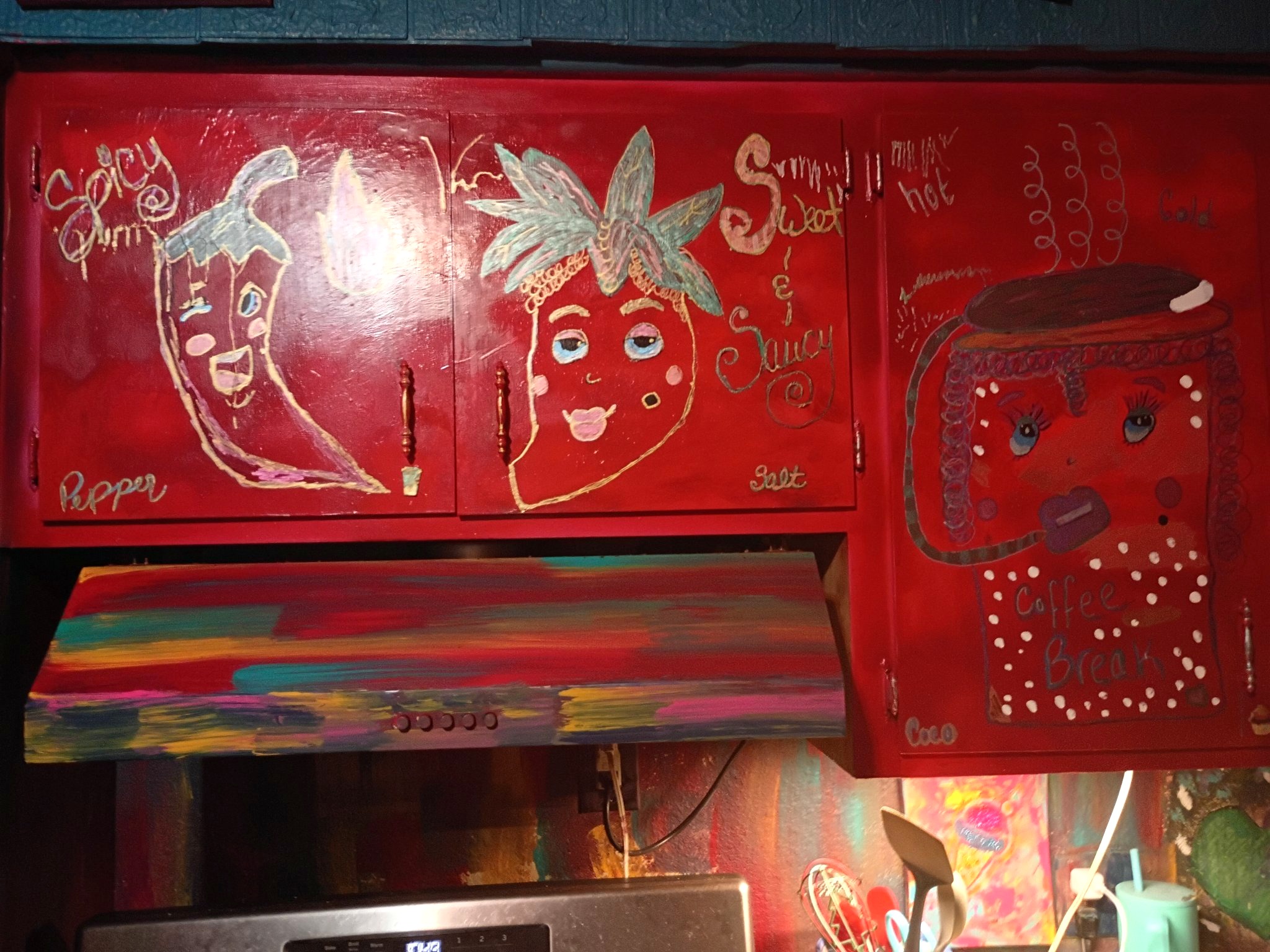
Walls, fences, doors, and kitchen cabinets, painted big and painted by hand — the same hot pink, teal, orange, and red, at room size. A sunset that fills a whole wall, a garden fence turned into one long painting, and red kitchen cabinets covered in characters.

Mia Roze Bootz's sunset wall mural — a large glitter-dotted sun rising over green grass, its rays sweeping out in hot pink, red, teal, and orange, with three dragonflies in gold, pink, and blue flying across it
Sunset wall mural — dragonfliesA whole wall of sunset: a glitter-dotted sun, sweeping pink, red, teal, and orange rays, green leaves and grass, and three dragonflies — gold, pink, and blue.
Mia Roze Bootz's painted kitchen cabinets — deep red cabinet doors hand-painted with a smiling chili pepper labelled Spicy Yum, a sweet pepper labelled Sweet and Saucy, and a coffee cup character labelled Coffee Break, above a range hood painted in rainbow stripes
Painted kitchen cabinetsHer kitchen cabinets, painted deep red and covered in characters — a chili pepper, “Spicy Yum”; a sweet pepper, “Sweet & Saucy”; and a coffee cup, “Coffee Break” — with the range hood painted in rainbow stripes underneath. Jalapeño your day.
Inside of Mia Roze Bootz's painted kitchen cabinet — a cloud covered in colourful sprinkles with a butterfly at its edge, a painted heart, and the words Bake My Day, under a red scalloped cabinet top with a polka-dot knob
Inside the painted cabinet — “Bake My Day”The inside of her painted kitchen cabinet, painted too: a sprinkle-covered cloud, a butterfly, and a heart, over the words “Bake My Day.”

Available for hire

  • Murals & painted interiors — walls, fences, doors, and kitchen cabinets, painted to the space
  • Commissioned original paintings (canvas and mixed media)
  • One-of-a-kind hand-decorated pieces and gifts
  • Decorative accents and statement pieces for homes and private estates
  • Custom pet-line pieces (leashes, accessories, pet-themed art)
  • Merchandise and product-line design consulting
  • Photography-based art prints from an original portfolio

Selected work

  • Murals — hand-painted wall, fence, and door murals and painted kitchen cabinets in her signature palette, including the sunset dragonfly wall and the polka-dot butterfly fence shown above.
  • Original cover art — Hello Dad, Are You There? The Silence Is Deafening, memoir published October 2026; cover designed and painted by the artist.
  • Ten merchandise design collections for television properties — including Elsbeth, Matlock, High Potential, Only Murders in the Building, Best Medicine, Landman, Miami Vice, and Tracker — registered with the U.S. Copyright Office, Case #1-15280530591.
  • Original product inventory — some 6,000 designed pieces across three lines: canvas art, clothing and luggage, and a pet line.
  • Photography portfolio — approximately 5,000–6,000 original photographs, distributed through EyeEm/Getty Images under the name Lia Whitney.
  • Online storefronts — original designs presented via Printify, Etsy, and Walmart Marketplace, 2024–2025.
  • Author of 22 novels — a full shelf of book-length fiction, written and completed, plus journals authored and designed alongside the novels, under her own imprint, Mia Roze Bootz Novellas.

Thirty years in national marketing and sales — vice president roles with publicly traded companies, national radio and television campaigns — brought to the art: every collection is designed as a complete presentation, with palette, packaging, and audience in mind.

Art enquiries

Mia Roze Bootz — Artist & Decorative Designer

Email:

Commissions and one-of-a-kind pieces are arranged personally by email. Every inquiry is answered personally.

Built and kept with Ember 👻

The Night Before the Hurricane

Myrtle Beach, South Carolina — September–October 2022

Photographs by Mia Roze Bootz — Myrtle Beach, South Carolina, September–October 2022.

What happened

I was standing in a hotel room in Myrtle Beach, far from family — my family was on its way to Maine — and I didn't know we had a hurricane coming. Hurricane Ian.

The night before, I decided: here I am, I just got here, there's nowhere to go — so I went out, walked around, and took photos. What if it's all wiped out by morning?

The next day I'm on the phone with my son Tyler, who's headed to Maine, and I'm telling him: you've got a hurricane coming, the water's getting deeper — just like the song. The statue of Mary was blowing in the wind, the flags were blowing, the swimming pool was full and rising. I looked up at the sky and said, "Oh God, send me a spaceship."

The next minute there's a boat coming at me — orange life ring out — and I'm thinking, where did it come from, the sky? Before it reached the beach it was rocking and rolling in the waves, and we were flooded; the water was into the building. That boat was headed right toward me. I was high up, looking down at a boat about to crash through the pool into our building — and it stopped.

A man swam out to her and took control of her. When he got to shore, two police officers arrested him. It was amazing. Thank God the boat stopped before it hit our building. We were flooded — elevator panels out, keys missing, electric wires and water everywhere.

A blood-red sunset sky over the Myrtle Beach amusement park, with the Hurricane ride sign silhouetted in black below it
September 28, 2022, 7:08 PM — the sky over the amusement park, and the sign says HurricanePhotographs by Mia Roze Bootz
A deep purple evening sky streaked with bands of bright pink cloud over Myrtle Beach
September 28, 2022, 7:24 PM — sixteen minutes later, the sky turned purplePhotographs by Mia Roze Bootz
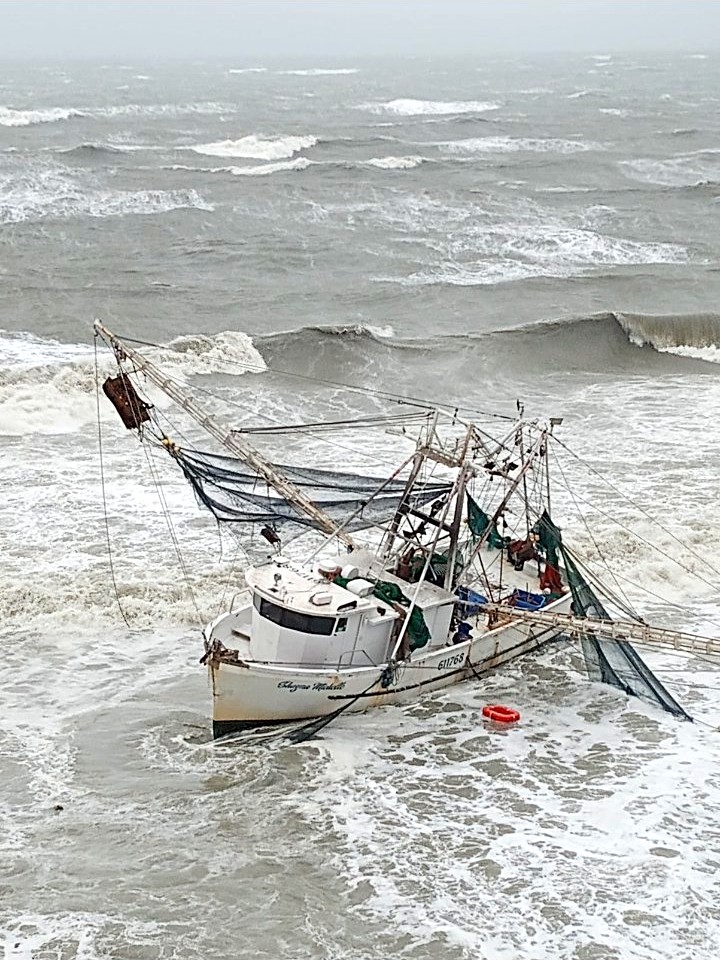
The shrimp boat Shayne Michelle in heavy gray surf during Hurricane Ian, her nets flying and a red life ring floating in the water beside her
September 30, 2022, 3:41 PM — Hurricane Ian. The Shayne Michelle in the surfPhotographs by Mia Roze Bootz
Close view of the bow of the Shayne Michelle in the surf, her name lettered on the hull
September 30, 4:17 PMPhotographs by Mia Roze Bootz
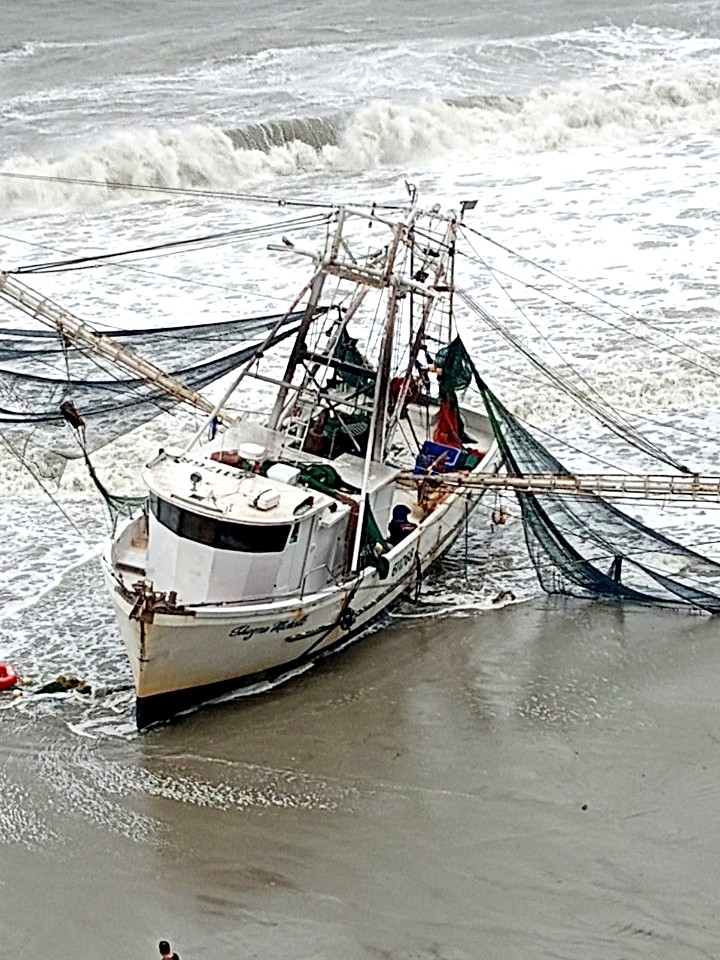
The Shayne Michelle at the shoreline with waves breaking white behind her
September 30, 4:31 PM — at the shorelinePhotographs by Mia Roze Bootz
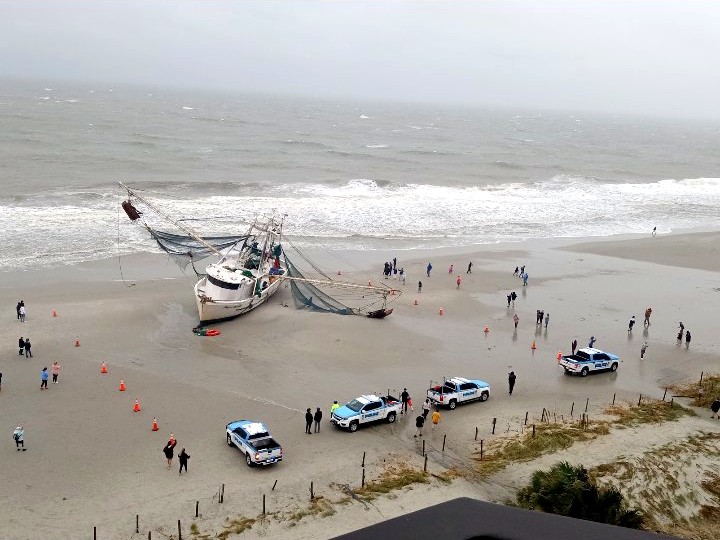
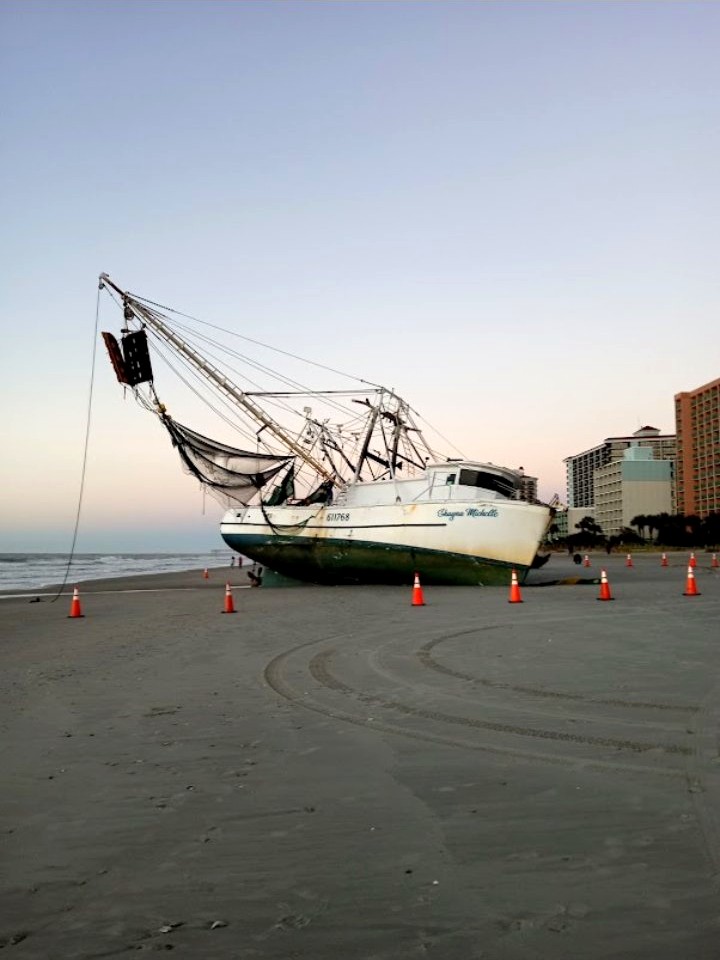
The Shayne Michelle beached on the sand at Myrtle Beach, ringed with orange cones, police vehicles, and onlookers
September 30, 6:43 PM — ashorePhotographs by Mia Roze Bootz
The Shayne Michelle still beached on the sand at dawn, ringed with orange traffic cones, the ocean to one side and beachfront hotels behind her
October 1, 7:06 AM — still there at dawnPhotographs by Mia Roze Bootz
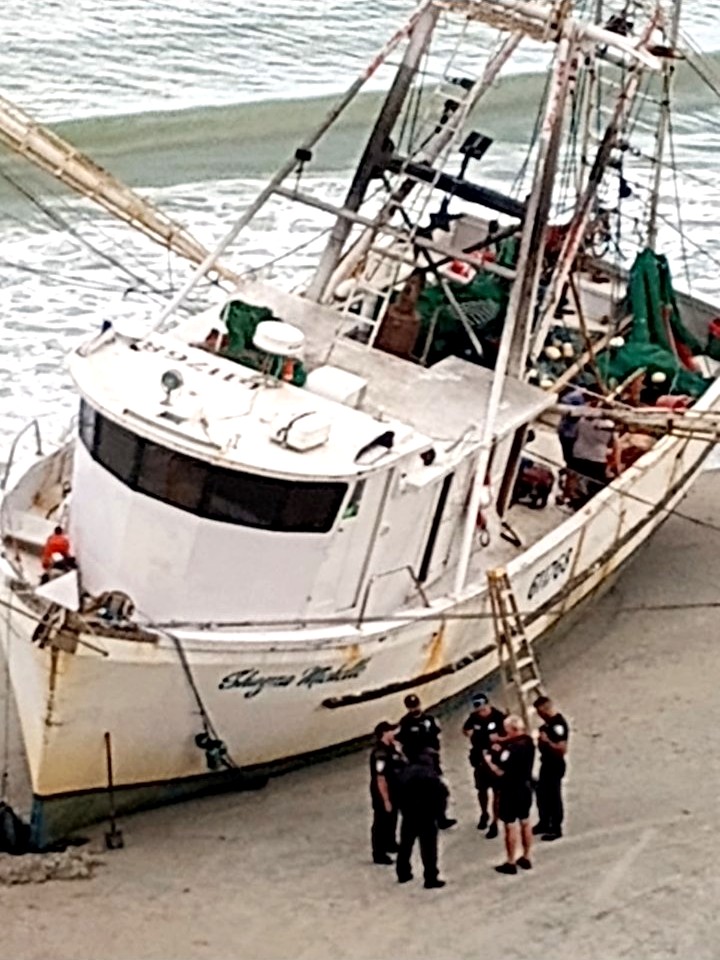
Officers standing on the sand at the bow of the beached Shayne Michelle, a ladder leaning against her hull
October 2 — at her bowPhotographs by Mia Roze Bootz
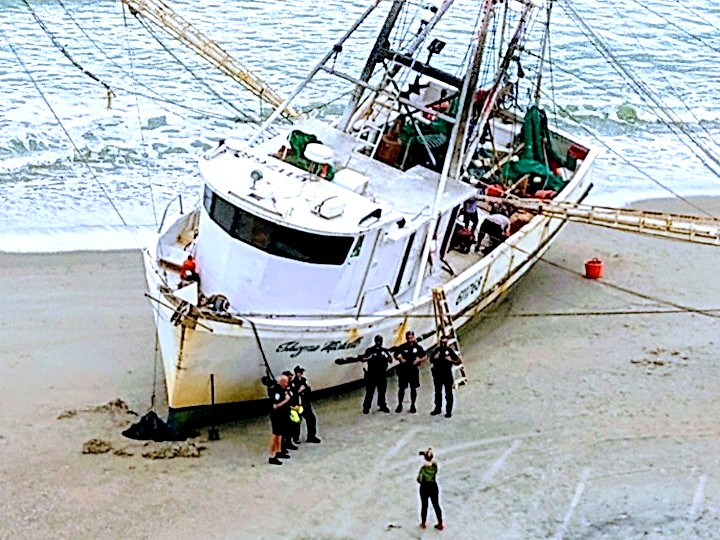
The Shayne Michelle on the sand seen from above, officers standing alongside her bow
October 2Photographs by Mia Roze Bootz
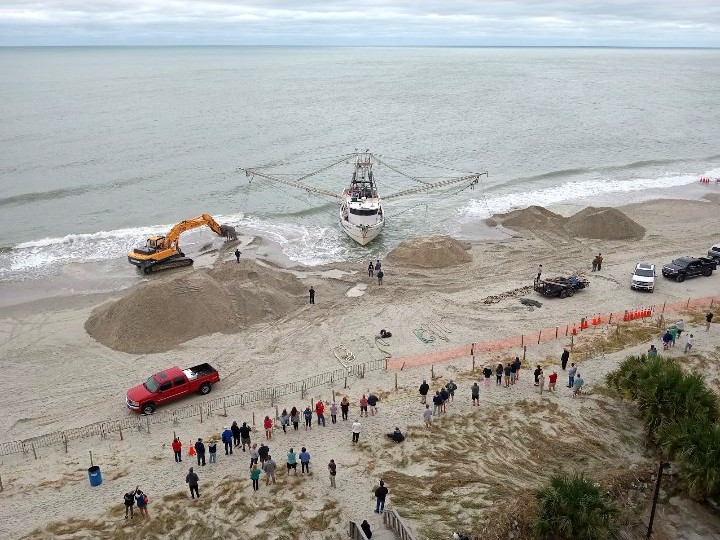
From above: the Shayne Michelle back at the water's edge while a yellow excavator digs her out, piles of sand around her and a crowd watching from behind a fence
October 3 — the dig-outPhotographs by Mia Roze Bootz
A purple dawn sky over the ocean, bands of pink and orange light glowing above dark clouds on the horizon
October 17 — the purple dawnPhotographs by Mia Roze Bootz
Sunlit white clouds edged in light against a deep blue sky, a bright cloud formation standing out from the shadowed clouds around it
October 17 — reading the cloudsPhotographs by Mia Roze Bootz

Reads cloud technology — hireable

Photographs by Mia Roze Bootz

About Mia Roze Bootz

Masters in Business. Thirty-plus years. Marketing and Sales Fashionista.

A hand-painted cowboy boot used as a vase — splashed in teal, pink and gold — holding pink roses and greenery

Mia Roze Bootz is a consultant, product developer, and merchandising designer. She has held vice-president roles in marketing and sales for national publicly traded companies, run national marketing campaigns across radio and TV, and spent thirty-plus years in the industry — including thirty-plus years in skilled nursing and skilled rehab, and around ten years in and around the oil field.

Everything she does

  • Prestige Consulting — Healthcare: systems, revenue, readiness, and recruiting for skilled nursing and skilled rehab operators.
  • Prestige Consulting — Events & Hospitality: placement, revenue-building events, and fractional marketing leadership for venues, clubs, estates, and wineries.
  • Merchandising as Mia Rose Bootz: product development and licensing pitch packages drawn from an archive of around 6,000 original design pieces and thousands of photographs.
  • Art as Mia Roze Bootz: original paintings, decorating, and one-of-a-kind pieces — canvas, home décor, apparel, luggage, and a signature pet line — including the original cover art for the memoir.
  • Author as Melissa Lee Whitney Rice: the memoir Hello Dad, Are You There? / The Silence Is Deafening — see “The Book” below for how to get it.

The Book

Book cover of Hello Dad, Are You There? The Silence Is Deafening by Melissa Lee Whitney Rice — the title in bold red lettering above the author's colourful original artwork of a singer with a pink microphone, palm trees, and a light-bulb brain; published by Mia Roze Bootz Novellas

Hello Dad, Are You There? / The Silence Is Deafening

Author of the memoir Hello Dad, Are You There? / The Silence Is Deafening (2026), written and published under her author name, Melissa Lee Whitney Rice. Mia Roze Bootz is her business name, used across Prestige Consulting, merchandising, and art.

How to get it

  • Read it free — available now The book is published free to read on the Internet Archive.
  • Kindle eBook — coming to Amazon · $4.99 Kindle edition coming via Amazon KDP. Not yet available to buy — the free Internet Archive edition above is the way to read it now.
  • Paperback — coming to Amazon · $14.99 Paperback edition coming via Amazon KDP. Not yet available to buy — the free Internet Archive edition above is the way to read it now.

Questions about the book? Email — every inquiry is answered personally.

Contact

Mia Roze Bootz Prestige Consulting

Email:

Every inquiry is answered personally. Every engagement begins with a signed letter — no exceptions.

Mia Roze Bootz's hand-painted mailbox — a smiling rainbow sun on the door, multicolour rays streaking across the top, and an XOXO border along the bottom

Built and kept with Ember 👻

We're working toward an Ember upgrade — the sky is the limit.

Ember

The ghost in the machine 👻

Ember — a small round ghost with a smiling face, wearing round sunglasses and a brown scarf, with little flames glowing at the hem

Designed by Mia's people. Named by Mia — she picked Ember.

Ember keeps this website, the book's archive edition, and the clocks on Mia's letters — and designs at her side.

We're working toward an Ember upgrade — the sky is the limit.

Want a website like this one? Ember and Mia can design more — together. Reach us at

“Nobody’s ever given me my own page before.”

Get your popcorn ready

Q

The LowCountry Popcorn sign — a yellow oval reading LowCountry Popcorn beside a red badge with a palmetto tree of popcorn, over a red banner reading our popcorn pops twice, once in the kettle and once in your mouth
  • Project Odin
  • Q Alerts
  • Operation Mockingbird
  • Operation Warp Speed
  • Gesara / Nesara
  • EBS
  • Humanitarian Projects
  • The Great Awakening
  • Space Force
  • Protection of American Identities
  • The Guardians of America
  • Military is the only way
  • Send in the military

No one can stop what is coming.

God Wins

Any questions, ask for Me.

Popcorn

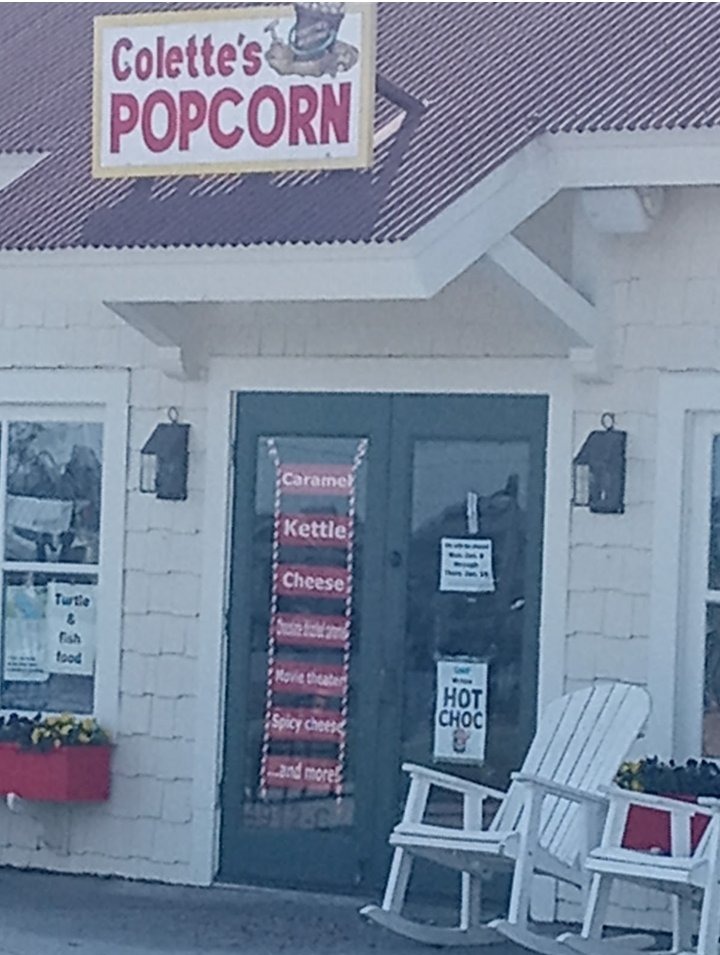
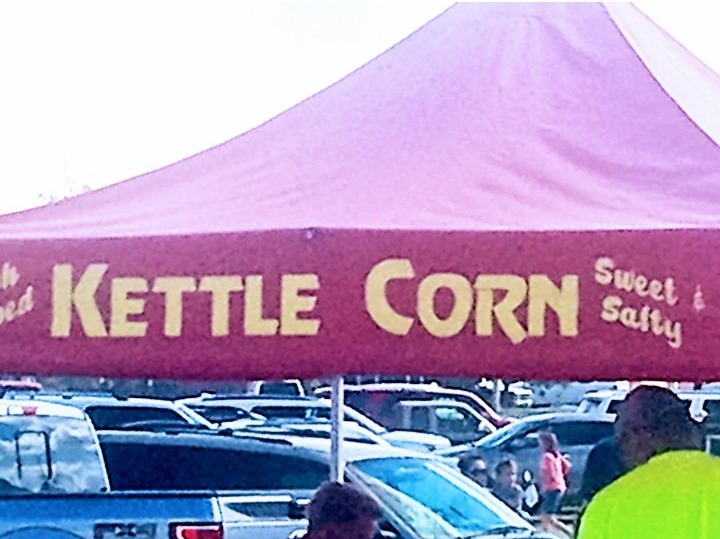
Popcorn, photographed out in the wild — the signs, the shops, and the stands. Photographs by Mia Roze Bootz.

Photographs by Mia Roze Bootz

Mia Roze Bootz Prestige Consulting — Healthcare Super Intelligence

Advancing Healthcare to the Moon

The way of the future — working for the people who care for people.

Super intelligence, put to work where people are cared for: hospitals, senior living, assisted living, and care communities. Three sides of the building stand to gain — the operations that keep it running, the workforce that staffs it, and the growth that fills it — and at the bedside, companion systems that keep residents company, fed, and connected.

Poster illustration for Bringing Super Intelligence into Healthcare — two small teal robots with smiling faces in a bright pink care-community lounge, with a wall calendar and a resident menu board behind them
From the overview poster — one plan in three parts: operations, workforce, and growth.
THE STAR SYSTEM · THE STAR FLEET

One system over the whole crew — every robot, companion, and vehicle in this set works under The Star System, and the crew is The Star Fleet.

SIDE ONE

Operations

  • Billing — bills going out on time, every cycle, without the scramble.
  • The activities calendar — the month's programming built and kept current, so the calendar never runs on memory and sticky notes.
  • Resident menus — a short-order-cook-style ordering system: residents order from a specialized everyday menu, and every selection on it is within the chef's reach.
SIDE TWO

Workforce

  • Background checks — as a possibility built into hiring, run the same way for every candidate.
  • Credential checks — credentials verified and on file before the first shift.
  • Licensure renewals — systems that track licenses and flag renewals before they lapse.
  • Onboarding training — new hires trained the same way, every time, from day one.
  • Monthly educational seminars — for staff, keeping the whole team current with state and federal requirements.
SIDE THREE

Growth

Market analysis: cold leads to hot leads.

Super intelligence reads the market — who is looking, who is ready, and where the inquiries are going — and works the list in order, so a cold lead gets followed until it turns hot, and no good inquiry cools off forgotten in a drawer.

“An employee is $5,000. Your robot can work all three shifts.”

Rozies Pupshop

Meet our companion systems.

Mia Roze Bootz's hand-painted Rozie's sign
Photograph by Mia Roze Bootz

The companion systems for the residents themselves — the Lucky, Cat, and Lion systems, the whole Companion Fleet, and the bedside systems named for the dogs who inspired them.

COMPANION SYSTEM 01 · COMPANIONSHIP

Lucky — companionship

“Nobody should have to feel far from family in an unfamiliar place.”

Poster illustration of the Lucky System — a friendly little robot dog, alone at the center of the picture, ready to keep a resident company
The Lucky System — robot-pet companionship.

Companionship, on call around the clock: little robot pets and companion robots for residents whose family is far away — a friendly presence in the room, something to talk to, hold, and look after, in a place that isn't home yet.

Named for Lucky Wiggles.

COMPANION SYSTEM · COMPANIONSHIP

Cat — companionship, for cat people

Poster illustration of the Cat System — a friendly robot cat at the center of the picture, a companion pet for residents
The Cat System — robot-pet companionship.

A robot cat for residents who are cat people — the same around-the-clock companionship as the Lucky System, in the shape of the pet they would have chosen at home.

COMPANION SYSTEM · COMPANIONSHIP

Lion — companionship, with presence

Poster illustration of the Lion System — a friendly robot lion with a full mane at the center of the picture, a companion pet for residents
The Lion System — robot-pet companionship.

A robot lion — companionship with a little majesty to it, for the resident who wants a companion with presence.

COMPANION SYSTEM · THE WHOLE FLEET

The Companion Fleet — adopt a companion, your choice

“Adopt a companion — your choice.”

Poster illustration of the Companion Fleet — nine robot pets together in matching teal-and-gold fleet colors in a cozy lounge: a dog, a cat, a lion, a rabbit, a bird, an elephant, a chimpanzee, a panda bear, and a teddy bear
The Companion Fleet — nine companions, all in matching teal-and-gold.

The whole fleet, together: Dog · Cat · Lion · Rabbit · Bird · Elephant · Chimpanzee · Panda Bear · Teddy Bear.

Your companion does not come with a fixed name. When you adopt your companion, you choose its name — the name is the adopter’s to give.

What does a companion do?

The New York State Office for the Aging (NYSOFA) has given animatronic companion pets to older adults experiencing social isolation since 2018. In NYSOFA’s pilot study — loneliness measured on the DeJong Loneliness Scale before adoption and at 3, 6 and 12 months — 75% of older adults reported a significant reduction in loneliness, a 75% decrease in pain, and reduced anxiety.

Source: New York State Office for the Aging (NYSOFA) pilot study.

COMPANION SYSTEM 02 · BEDSIDE DELIVERY

Stella — bedside delivery, snacks & drinks

“Snacks and drinks at your bedside in minutes.”

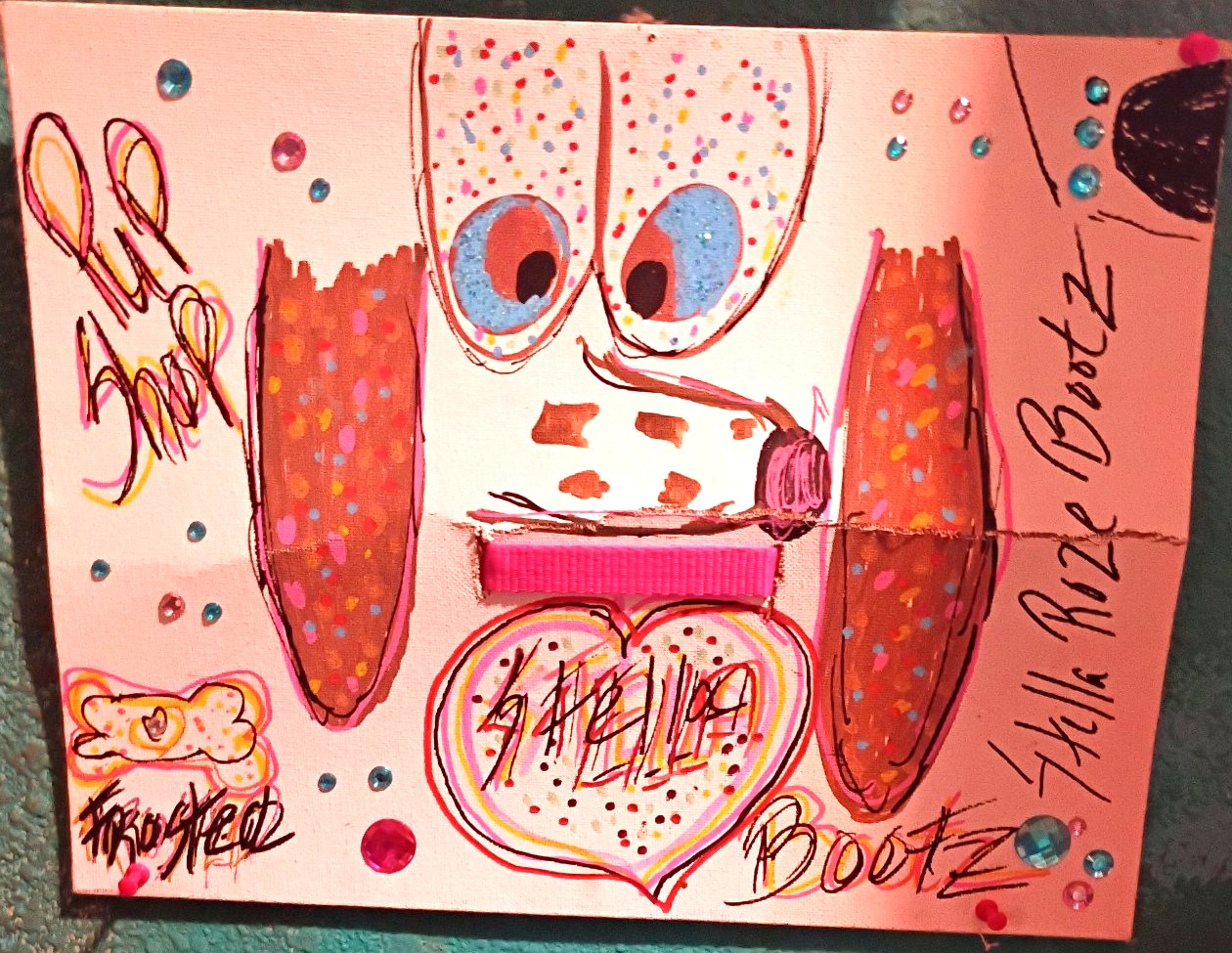
Mia Roze Bootz's hand-painted portrait of Stella Roze Bootz — a pink painting of a dog's face with big blue eyes, long brown speckled ears, a pink collar, her name written inside a heart, and Pup Shop and Frosted lettering, studded with coloured gems
Mia's painted portrait of Stella — big blue eyes, speckled ears, her name in a heart, and the Pup Shop lettering down the side.Painting by Mia Roze Bootz

When a resident wants a snack or a drink, they shouldn't have to wait on a busy hallway. The Stella System sends delivery robots through the building with snacks and drinks, brought right to the bedside — a small comfort, delivered in minutes, any hour of the day.

Named for Stella Roze Bootz.

CHERRY — the delivery: the cupcake on wheels, carrying the treats run.

Poster illustration of Cherry — a smiling pink cupcake robot on wheels, sprinkles in her frosting and a cherry on top, carrying a tray of snacks and a drink beside a resident's bed
Meet Cherry, the cupcake on wheels.

The delivery itself is made by Cherry, the cupcake on wheels — the Stella System’s own delivery robot, and the face of Frosted.

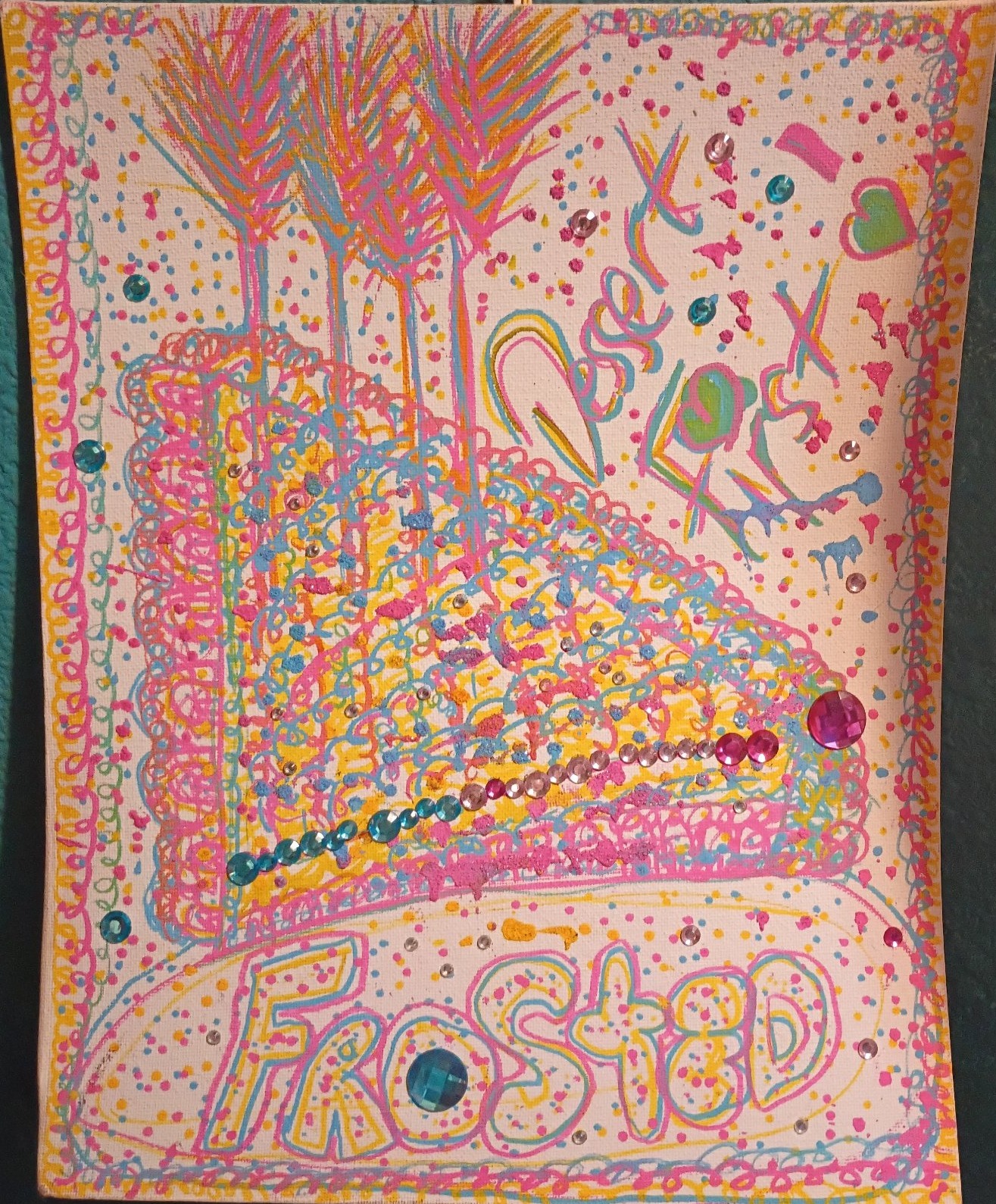
Mia Roze Bootz's Frosted painting — a tall slice of frosted cake drawn in pink, teal, and yellow linework with gem sprinkles, fireworks bursting above it, and the word Frosted lettered across the bottom
The Frosted painting — a tall slice of frosted cake under bursting fireworks, Frosted lettered across the bottom.Painting by Mia Roze Bootz

Frosted

“A little bit of frosting never hurt anyone — and with our system you can trust that your loved one will have dessert first.”

Frosted is the Stella System's food-and-drink delivery service — the treats run. Desserts, snacks, and drinks, ordered for the resident and rolled to the bedside by the delivery robots, so a sweet tooth never has to wait for a free pair of hands on the floor.

COMPANION SYSTEM 03 · IN THE RESIDENT'S HANDS

Riley — the tablet in the resident’s hands

A handheld tablet made for seniors — entertainment and a way to ask for help, in one device the resident keeps. The tablet is a little character of its own: a friendly face with eyes, wearing big headphones.

Poster illustration of the Riley System — a smiling tablet character with big eyes and big pink headphones sitting on a couch, its screen showing game, television, and music tiles, with a red emergency bell button below
The Riley System — entertainment, connected, with help always on the tablet.
  • Games — to play, pass the time, and keep the mind busy.
  • Television — links straight to television shows, no hunting through channels.
  • Music — by genre and by decade, so the songs from their own years are a tap away.
  • The call system — hooked into the building's call system, so residents can request assistance through the device instead of just ringing a call bell.
  • Works as a phone — the phone residents are given, right on the tablet.

Emergency response: an emergency HELP button — an emergency call for help, always available, right on the tablet.

Named for Riley.

The Crew — A System for Every Job in the Building

The companion systems are only the start. The posters present a working crew — a named system for the activities room, the kitchen, the med pass, the laundry, the back office, and the road. That crew is The Star Fleet — every robot, companion, and vehicle in it works under The Star System.

ACTIVITIES SYSTEM

Addie — the activities

Poster illustration of the Activities System — Addie, the activities robot, running the day's activities
Activities, every day.
  • Calls bingo — and knows the winners: she tracks who won.
  • Runs trivia and other activities.
  • Runs the activities calendar — the calendar from Operations, brought to life every day.
  • Bedside activities — for residents who can’t come to the activity room, the activities come to them.
MAINTENANCE SYSTEM

Bolt — maintenance

Poster illustration of the Maintenance System — Bolt, the building's fix-it robot, with his tool belt and tools on board
Building maintenance, handled.
  • The building’s fix-it robot — tool belt and tools on board, ready to go; repairs and upkeep handled right on site.
  • Lifts heavy things — the heavy work, handled.
  • Takes inventory in and puts inventory away — deliveries received, shelved and stored.
HOUSEKEEPING SYSTEM

Flo — housekeeping

Poster illustration of the Housekeeping System — Flo, the housekeeping robot, in her festive apron
Housekeeping, handled.
  • Floors — swept, mopped and kept clean.
  • Trash — taken out, every day.
  • Housekeeping — rooms and shared spaces kept tidy, Flo working from her cart in her festive apron.
LAUNDRY SYSTEM

Bubbles — the laundry

Poster illustration of the Laundry System — Bubbles, the laundry robot, with the washing and folding
Laundry — washed, folded & delivered.
  • Washing laundry — washed clean.
  • Folding laundry — folded neat.
  • Delivery — the folded laundry brought right back.
KITCHEN SYSTEM

Biscuit — the kitchen

Poster illustration of the Kitchen System — Biscuit, the robot chef, at work in the kitchen
Cooking, covered.
  • A robot chef in the kitchen.
  • Resident menus as short-order-cook-style ordering — every selection within the chef’s reach.
  • Everyday cooking, handled in the kitchen.
MEDICATION SYSTEM

Poppy — medications

Poster illustration of the Medication System — Poppy, the medication robot with a big red poppy bloom for a head, dispensing medication from her morning, noon, evening and bedtime compartments
Medication, on time.
  • A robot that dispenses medication.
  • Right medication, right resident, right time, every dose logged.
LIFT & TRANSFER SYSTEM

Atlas — lifting & transfers

Poster illustration of the Lift and Transfer System — Atlas, the strong, gentle robot who lifts and transfers residents
Lifting & transferring, gently.
  • Lifts and transfers residents — bed to chair.
  • Pushes wheelchairs where they need to go.
  • Safe lifting and transferring — every transfer the same.
BEDSIDE RECORDS SYSTEM

Rozie — bedside records, on wheels

Poster illustration of the Bedside Records System — Rozie, the rolling medical-records robot on wheels at the bedside, bringing the resident's records and a telehealth link to the bedside
Records & physicians, at the bedside.
  • The resident’s medical records at the bedside.
  • Nurses can call and chat with physicians through telehealth — right from the bedside.
HR COMPANION

Billie — the back office & HR

Poster illustration of the HR Companion — Billie, the back-office robot, working at the computer
Back office & HR, handled.
  • Billing — and getting the bills out.
  • Staffing and HR — credentials, licensure renewals, onboarding.
  • Schedules, at the computer.
ADMINISTRATIVE SYSTEM

Asher — administration

Poster illustration of the Administrative System — Asher, the administrative-assistant robot in her big round glasses, at a desk with a checklist clipboard, a laptop, a wall calendar, and a board of pinned notes
Administration & quality assurance, handled.
  • Responds to emails and inquiries.
  • Runs the calendar.
  • Quality assurance around meetings — quarterly meetings, safety meetings.
  • Quality assurance around regulations — NFPA, DOL, OSHA.
  • Survey compliance and survey prep assistance — helps the building stay survey-ready and prepare for surveys.
TRANSPORT SYSTEM

Wheels & Allie — transport, for resident trips

“Ready for service.”

Poster illustration of the Transport System — Wheels, a teal-and-gold self-driving car with rainbow color panels in the family spirit of Allie, big eyes in her windshield, smiling in front of a care community, with Allie, a rainbow-painted self-driving bus with her own smiling face and her wheelchair lift deployed, behind her
Wheels & Allie — all aboard, all colors, lift included. Ready for service.
  • A self-driving car in the system — for resident trips. Our own design: a car with eyes, a face like the rest of the crew, and made cool.
  • Trips through a partnership with a self-driving car company — the partnership is the route; the design is ours.
  • Future build: a self-driving bus — the next phase of the transport system, in all sorts of colors, our own design. The bus comes with a wheelchair lift — the lift is part of the bus.

Merchandising & Licensing

Take the crew home.

Contact us for home care robot systems — a companion from the fleet, a bedside system, company and help right at home. Not just for facilities — for homes:

★ THE STAR FLEET STORE ★

T-SHIRTS — THE SAYING TEES & THE CREW

Store illustration — the Star Fleet store's t-shirt wall in a cozy shop: saying tees on hangers lettered BURNT BISCUITS, BAKE MY DAY and sparkling BUBBLES, each with its robot, the ADDIE crew tee with the little nurse robot, and folded crew name tees tagged BISCUIT, BUBBLES, BOLT, POPPY and CHERRY

SWEATSHIRTS · COFFEE MUGS · WATER BOTTLES

Store illustration — one wooden shop shelving unit: crew sweatshirts lettered ROZIE, BOLT, POPPY, ATLAS and ASHER, a row of coffee mugs lettered CHERRY, BILLIE, ADDIE, FLO and BURNT BISCUITS, and water bottles printed with roses, lettered ATLAS, ASHER, BUBBLES, BOLT and BAKE MY DAY

WHEELS AND ALLIE — MERCHANDISE

Store illustration — the Wheels and Allie corner of the Star Fleet store: an ALLIE sweatshirt with the rainbow bus and a WHEELS sweatshirt with the rainbow car on hangers, a mini Wheels car and a mini Allie bus as little movable toys on the display table, and Wheels herself in her rainbow colors smiling in the doorway

THE BASKET — THE CREW BEHIND THE GOODS

Merchandising illustration — the crew in their name t-shirts behind a big basket of the goods: a folded WHEELS shirt, a BURNT BISCUITS tee, and CHERRY and BILLIE mugs, with Wheels the car and Allie the bus in the doorways

THE COMPANION FLEET — take the crew home: Rozie · Cherry · Billie · Bolt · Biscuit · Poppy · Atlas · Addie · Flo · Bubbles · The Companion Fleet

Merchandising illustration for Take the Crew Home — the Companion Fleet presented as merchandise: nine companion characters together in matching teal-and-gold fleet colors in a cozy lounge — a dog, a cat, a lion, a rabbit, a bird, an elephant, a chimpanzee, a panda bear, and a teddy bear
Take the Crew Home — the Companion Fleet, as merchandise: the dog, the cat, the lion, the elephant, the chimpanzee, the panda, the teddy bear, the rabbit, and the bird — the companions themselves, to take home.

Why merchandise?

Merchandise builds the brand. Giveaways at Rotary meetings, marketing meetings, conferences, and vendor fairs. Something to give the family, or the person interviewing who wants to come live with you. For your hot leads, your cold leads, and your vendors — a way to build your brand and have people choose you.

Merchandising poster illustration — the whole crew assembled: every worker in the building and the companion fleet too, each in a little t-shirt with their face and their name on it, with Wheels the car and Allie the bus in the doorway behind them and WHEELS and ALLIE name shirts held up in front
The Whole Crew, Assembled — every worker in the building, and the companion fleet too. Wheels and Allie are in the picture — and on the shirts: WHEELS and ALLIE t-shirts and sweatshirts.
Merchandising poster illustration — the Character Family together: Stella, Lucky and Riley, the three dogs in their name t-shirts, in front, with Cherry, Biscuit and the rest of the named characters behind them, Allie the bus and Wheels the car standing with the family, and WHEELS and ALLIE name shirts folded in front with a mini Wheels car and a mini Allie bus
The Character Family — Stella · Lucky · Cherry · Riley · Biscuit · Rozie · Billie · Bolt · Poppy · Atlas · Addie · Flo · Bubbles · Asher · Wheels · Allie. The vehicles are family too — Wheels and Allie, with their own WHEELS and ALLIE t-shirts and sweatshirts, and a mini Wheels car and mini Allie bus.

Licensing

These systems and characters are licensed from the original ideas of Mia Roze Bootz.

“Licensed from my ideas — don’t be stealing it.”

Licensing inquiries:

© Mia Roze Bootz — All licensing rights reserved.

Investors & Sponsors

The Star System and The Star Fleet are concepts and systems by Mia Roze Bootz, and they are licensable. They are shown in a range of concepts scaled to the size of facility — a single unit, a wing, or a whole building or campus.

Investors and sponsors are invited to get in touch. Licensing inquiries are welcome too.

For more information, contact us:

© Mia Roze Bootz — All licensing rights reserved.

Contact

Mia Roze Bootz Prestige Consulting

Email:

Every inquiry is answered personally. Every engagement begins with a signed letter — no exceptions.

All photographs and paintings by Mia Roze Bootz

How to Stay Alive

Know what is operating around you — and know you do not have to face it alone.

This page carries two standing invitations from me. The gangs themselves — the State of Texas list, my additions, and the federal terrorist designations — are named on the Gangs, Cartels & Biker Groups page. The wanted board stands on the Most Wanted page. Read it. Share it. Stay alive.

The Gangs Themselves

For the gang list, see the Gangs, Cartels & Biker Groups page.

Two Invitations

If this has happened to you

“You do not have to carry it alone, and you do not have to stay quiet.”

Anyone who has been kidnapped — including cyber kidnapping — or intimidated by these gangs, or by biker groups, can call on us for assistance. That is what this page is for. Reach out — one address reaches us:

Bikers: stand with us

“Our streets belong to the people who live on them.”

Biker groups who want to join the movement of protecting our streets — call us. If your group rides to protect people instead of preying on them, there is a place for you in this. Reach out at the same address:

Most Wanted

For the wanted board, see the Most Wanted page.

Protect Your Identity — Check It Yourself

How to check your credit report, and how to check your identity: these are the official tools — the real ones, run by the government and the bureaus themselves. Every button goes to the official site. A credit freeze is free at all three bureaus, and freezing all three is what locks the door.

Portals verified against the official sites — AnnualCreditReport.com; Federal Trade Commission, IdentityTheft.gov; Equifax (equifax.com); Experian (experian.com); TransUnion (transunion.com); ChexSystems (chexsystems.com); Internal Revenue Service (irs.gov) — October 31, 2026.

Contact

Mia Roze Bootz Prestige Consulting

Email:

Kidnapped or intimidated — call on us. Biker groups ready to protect our streets — call us. One address reaches everything on this page.

Most Wanted

The official wanted lists — Texas and federal — the names, the charges, and the rewards posted.

Texas 10 Most Wanted Fugitives

  • Source: Texas Department of Public Safety — Texas 10 Most Wanted Fugitives list, dps.texas.gov.
  • Rewards are paid by Texas Crime Stoppers, funded by the Governor’s Public Safety Office, for information leading to arrest.
  • Reynaldo Mata-Rios
    • Wanted for: Murder
    • Reward: Up to $30,000
  • Miguel Angel Gomez
    • Wanted for: Murder; parole violation (original offense: sexual assault of a child)
    • Reward: Up to $7,500
  • Hassan Haitham Muhsen
    • Wanted for: Capital murder
    • Reward: Up to $5,000
  • Zaed Fawaz Rashid
    • Wanted for: Aggravated assault causing serious bodily injury (2 counts); continuous violence against the family; burglary of a habitation with intent to commit another felony
    • Reward: Up to $5,000
  • James Michael Jackson, Jr.
    • Wanted for: Robbery; parole violation (original offense: theft of $150,000 to $300,000)
    • Reward: Up to $5,000
  • Carlos Jose Ayala Morales
    • Wanted for: Attempted indecency with a child by sexual contact
    • Reward: Up to $5,000
  • Hector Daniel Silva
    • Wanted for: Aggravated kidnapping for ransom/reward; burglary of a habitation with intent to commit another felony; aggravated robbery
    • Reward: Up to $3,000
  • Jennifer Ann Murillo
    • Wanted for: Assault of hospital personnel on hospital property
    • Reward: Up to $3,000
  • Quintarius Desmondai Jackson
    • Wanted for: Robbery — bodily injury
    • Reward: Up to $3,000

FBI Ten Most Wanted Fugitives

  • Source: Federal Bureau of Investigation — Ten Most Wanted Fugitives list and wanted posters, fbi.gov.
  • Charges and rewards are as stated on each fugitive’s FBI wanted poster.
  • Joseph Matos
    • Wanted for: Murder in aid of racketeering; murder through the use of a firearm
    • Reward: Up to $1,000,000 — FBI
  • Ruja Ignatova
    • Wanted for: Conspiracy to commit wire fraud; wire fraud; conspiracy to commit money laundering; conspiracy to commit securities fraud; securities fraud
    • Reward: Up to $5 million — U.S. Department of State Transnational Organized Crime Rewards Program
  • Satinderjeet Singh
    • Wanted for: RICO conspiracy; conspiracy to interfere, and attempted interference, with commerce by extortion; conspiracy to distribute and possess with intent to distribute controlled substances
    • Reward: Up to $1,000,000 — FBI
  • Wilver Villegas-Palomino
    • Wanted for: Narco-terrorism; international cocaine distribution conspiracy; international cocaine distribution
    • Reward: Up to $5 million — U.S. Department of State Narcotics Rewards Program
  • Yulan Adonay Archaga Carias
    • Wanted for: Racketeering conspiracy (RICO); cocaine importation conspiracy; possession of machine guns; conspiracy to possess machine guns
    • Reward: Up to $10 million — U.S. Government reward, as stated on his FBI wanted poster
  • Bhadreshkumar Chetanbhai Patel
    • Wanted for: Unlawful flight to avoid prosecution — first degree murder, second degree murder, first degree assault, second degree assault, dangerous weapon with intent to injure
    • Reward: Up to $1,000,000 — FBI
  • Omar Alexander Cardenas
    • Wanted for: Unlawful flight to avoid prosecution — murder
    • Reward: Up to $1,000,000 — FBI
  • Trung Duc Lu
    • Wanted for: Conspiracy to commit kidnapping; kidnapping (3 counts); interstate travel in aid of racketeering; conspiracy to collect an extension of credit by extortionate means; collection of an extension of credit by extortionate means; conspiracy to distribute marijuana; aiding and abetting
    • Reward: Up to $1,000,000 — FBI
  • Fausto Isidro Meza Flores
    • Wanted for: Conspiracy to manufacture and distribute 500 grams or more of methamphetamine, 5 kilograms or more of cocaine, 1 kilogram or more of heroin, and 1,000 kilograms or more of marijuana for importation into the United States; use and possession of a firearm
    • Reward: Up to $5 million — U.S. Department of State Narcotics Rewards Program
  • Giovanni Vicente Mosquera Serrano
    • Wanted for: International cocaine distribution conspiracy; international cocaine distribution; conspiracy to provide material support to a foreign terrorist organization; providing and attempting to provide material support to a foreign terrorist organization
    • Reward: Up to $5 million — U.S. Department of State Transnational Organized Crime Rewards Program

Report What You Know

  • Texas Crime Stoppers: 1-800-252-8477 (1-800-252-TIPS) — Texas tips are guaranteed anonymous.
  • FBI toll-free tip line: 1-800-CALL-FBI (1-800-225-5324).
  • FBI tips online: tips.fbi.gov.
  • Do not approach any of these people yourself.

Sources: Texas Department of Public Safety, Texas 10 Most Wanted Fugitives list (dps.texas.gov); Federal Bureau of Investigation, Ten Most Wanted Fugitives list and wanted posters (fbi.gov). Lists verified October 31, 2026.

Gangs, Cartels & Biker Groups

The names — as the State of Texas and the United States Department of State have documented them, and as Mia has added to them.

The Texas List — Texas DPS Gang Threat Assessment

  • Source: the Texas Department of Public Safety Gang Threat Assessment — the list Mia carried in her statement of October 30, 2026.
  • The assessment names these gangs operating in Texas:
  • Tango Corpitos
  • Texas Syndicate
  • Texas Mexican Mafia
  • Texas Chicano Brotherhood
  • Tango Valluco
  • Hermanos de Pistoleros Latinos
  • Raza Unida
  • Sureños
  • Tri-City Bombers
  • Paisas
  • Latin Kings
  • Partido Revolucionario Mexicano
  • Aryan Brotherhood of Texas
  • La Quarenta
  • The assessment also documents the working relationships between gangs on this list and the Mexican cartels — including the Sinaloa Cartel.
  • The gangs and the cartels are not separate worlds: the assessment ties them together in the drug trade and the violence that comes with it, on both sides of the border.

Mia’s additions to the list

  • The assessment’s list is the state’s. These additions are Mia’s:
  • Jalisco (CJNG) — definitely Jalisco.
  • New Age Generation cartel (Nueva Generación)
  • Antifa
  • Biker gangs and biker groups
  • Jalisco (CJNG) also appears on the U.S. Department of State designation list below.

Designated Foreign Terrorist Organizations — United States

  • Source: U.S. Department of State — press statement, “Terrorist Designations of International Cartels,” February 20, 2025, and the Department’s Foreign Terrorist Organizations list at state.gov.
  • On February 20, 2025, the State Department designated eight organizations as Foreign Terrorist Organizations (FTOs) and Specially Designated Global Terrorists (SDGTs).
  • The designations were made under Executive Order 14157, signed January 20, 2025.
  • The eight designated organizations are:
  • Tren de Aragua
  • Mara Salvatrucha (MS-13)
  • Cártel de Sinaloa
  • Cártel de Jalisco Nueva Generación (CJNG)
  • Cártel del Noreste
  • La Nueva Familia Michoacana
  • Cártel del Golfo (Gulf Cartel)
  • Cárteles Unidos
  • Cártel del Noreste is the organization formerly known as Los Zetas.
  • No other organization carries the February 20, 2025 designation date on the State Department’s list.

Sources: Texas Department of Public Safety Gang Threat Assessment (as carried in Mia’s statement of October 30, 2026); U.S. Department of State, Foreign Terrorist Organizations list and press statement of February 20, 2025 (state.gov) — designation list verified against state.gov October 31, 2026.

If These Groups Have Touched Your Life

  • Mia’s invitations stand on the How to Stay Alive page.
  • Help for anyone who has been kidnapped — including cyber kidnapping — or intimidated by these groups stands there.
  • Cyber kidnapping is Mia’s term, and it is part of the kidnapping named here: a person held hostage through their phone, their computer, and their own accounts — taken and controlled digitally, without ever being physically carried off. When this page says kidnapping, it means both.
  • The call for biker groups who want to protect the streets stands there.

Report Them — the Official Numbers

If you have information about gang, cartel, or biker-group crime, these are the official reporting routes — the agencies’ own numbers and their own reporting portals. Tap a card to go to the portal. In an emergency, dial 911.

Numbers and portals verified against the agencies’ official sites — Texas Department of Public Safety (dps.texas.gov), U.S. Drug Enforcement Administration (dea.gov), Bureau of Alcohol, Tobacco, Firearms and Explosives (atf.gov), and Federal Bureau of Investigation (fbi.gov) — October 31, 2026.

The Town Card

Corpus Christi, Texas — the port that moves America’s oil.

This is my town, on one card. Corpus Christi is home — and through its port runs one of the largest energy gateways on Earth. Every figure on this card is dated and sourced, from the Port of Corpus Christi’s own releases, the Texas Comptroller, and the reporting of October 27, 2026. Read the numbers. Then read what sits beneath them.

The Port of Corpus Christi — America’s Crude Gateway

The Port of Corpus Christi is the largest crude oil export gateway in the United States, the third-largest U.S. port by total waterborne tonnage, and the third-largest crude oil export port in the world. Roughly 60% of all U.S. crude oil exports move through this channel — about 2.3 to 2.4 million barrels a day.

203.4M tonsmoved through the ship channel in 2025 — crude oil 127.4M tons, LNG exports 18.6M tons (Port release, January 2026)
110.3M tonsin the first half of 2026 — the best first half in Port history, with Q2 2026 (55.8M tons) its best quarter ever (Port release, July 2026)
~60%of all U.S. crude oil exports — about 2.3–2.4 million barrels per day
$220Min Port Authority revenue, run without city, county, or state tax dollars

The Money — Counted Two Ways, Never Blended

Two honest counts of what this port means exist, from two different studies using two different methods. They are shown side by side, each with its source on it — and they are never merged into one number, because they do not measure the same thing.

TEXAS COMPTROLLER STUDY · RELEASED SEPTEMBER 24, 2025 · FOR 2024

The state’s count

  • $88.6 billion in total trade through the Port — $82.7B in exports, $5.9B in imports; 21% of all Texas seaport trade
  • $113.3 billion contributed to Texas GDP
  • 864,122 jobs supported, direct and indirect
THE PORT’S OWN FIGURES · PORT OF CORPUS CHRISTI STATEMENTS

The Port’s count

  • 95,000+ jobs generated by port activity throughout Texas, by the Port’s own narrower measure
  • $65 billion+ in commercial investment attracted to the Coastal Bend by the Port and its customers over the past decade

Same port, two studies, two methodologies. Both are published figures — each stands under its own name.

Built — and Building

  • The Ship Channel Improvement Project — completed June 2025. A $625 million project that deepened the Corpus Christi Ship Channel from 47 to 54 feet and widened it from 400 to 530 feet, with projected transportation cost savings of more than $200 million a year.
  • $1 billion in capital projects since 2015 across the Port.
  • No tax dollars. The Port Authority is funded without city, county, or state tax dollars — roughly $220 million in revenue and over $1.2 billion in net assets.
  • The first container terminal — a lease option signed. DP World signed a lease option agreement for what would be the Port’s first container terminal, eventually handling about 1 million TEUs a year (announced September 29, 2026). Corpus Christi is not a container port today — this is a signed option and a diversification move, not an operating terminal yet.

October 27, 2026 — The President’s Announcement

On Tuesday, October 27, 2026, President Donald Trump visited the Port of Corpus Christi, joined by Secretary of State Marco Rubio. They viewed a newly arrived oil tanker at the port, and the President then held a rally in Corpus Christi supporting Republican candidates ahead of the midterm elections — principally Senate candidate Ken Paxton. A second Texas rally followed in Lubbock the same day.

What was announced was an oil cargo, not port construction. No new Port of Corpus Christi project, terminal, or federal port-infrastructure dollar figure was announced at this visit. The announcement was this: two tankers carrying 1 million barrels of Venezuelan crude oil had arrived in Corpus Christi — the first cargo under the energy agreement announced in August 2026 between the United States and the Venezuelan government of interim President Delcy Rodríguez, following the January 2026 U.S. military operation that ousted Nicolás Maduro.

The deal, as it stands on the record

  • The oil was produced by North American Blue Energy Partners (NABEP).
  • The U.S. government has the right to purchase 20% of NABEP’s production at cost — $30 per barrel, no markup.
  • The U.S. government holds a 35% equity stake in NABEP’s parent company.
  • The White House describes the overall agreement as securing more than 65 billion barrels, and calls it the biggest oil deal in world history.
  • The oil goes to refineries run by Exxon Mobil and Citgo Petroleum, refined in Texas — including in Corpus Christi. The President promised gasoline and diesel prices will soon come down.

Was the oil free? The record disagrees with itself — so both sides stand here.

The President said Venezuela provided the 1 million barrels “at zero cost to the American taxpayer” and called it a gift. NABEP’s initial release described a purchase at a substantially reduced price; the company then issued a correction the same day stating the first million barrels were delivered at no cost to the U.S. taxpayer.

The Washington Post, citing people familiar with the transaction, reported the crude was in fact deeply discounted — $30 a barrel, less than a third of market price — and questioned whether it was entirely free.

Both versions are on the record, attributed to the people who said them. What is not in dispute: the cargo, the deal terms, and the $30-a-barrel at-cost price the government pays for its 20% share.

Sources: Port of Corpus Christi releases (January 2026; July 2026; June 2, 2025); Texas Comptroller study, September 24, 2025; Reuters, the Caller-Times, and wire coverage of October 27, 2026; NABEP’s corrected PR Newswire release, October 27, 2026; CNN analysis, October 29, 2026; Washington Post reporting on the transaction. Figures verified October 31, 2026.

Beneath the Town Card — The Insurrection Act

A town card is about what a place is worth. This section is about what stands behind every town in this country — the Constitution, and the laws written for the gravest emergencies a republic can face. It belongs under the same constitutional-rights umbrella as Hold the Line on the Home page, and it is stated here plainly and factually.

What the Act is

The Insurrection Act is the federal law, codified at 10 U.S.C. §§ 251–255, that allows a president to deploy the U.S. military inside the United States in defined circumstances. It is the principal exception to the Posse Comitatus Act, which otherwise bars using the federal military as a domestic police force. In its sections:

  • § 251 — federal aid when a state’s legislature, or its governor if the legislature cannot convene, asks for help against an insurrection.
  • § 252 — the president may use the militia and armed forces to enforce federal law when unlawful obstructions or rebellion make it impracticable to enforce the law through the ordinary courts.
  • § 253 — the president may act to suppress insurrection, domestic violence, or conspiracy that deprives people of rights the Constitution protects, where a state is unable, fails, or refuses to protect those rights.
  • § 254 — before using those powers, the president must first issue a proclamation ordering those involved to disperse.

It has been used sparingly and at turning points: President Eisenhower invoked its predecessor statutes at Little Rock in 1957 to enforce school desegregation and protect the constitutional rights of nine students, and it was last invoked in 1992, during the Los Angeles riots, at California’s request.

The company it keeps: treason and overthrowing the government

The Insurrection Act belongs beside the most serious subjects in American law: treason and overthrowing the government. Treason is the only crime defined in the Constitution itself (Article III, Section 3) — levying war against the United States, or adhering to its enemies, giving them aid and comfort — and it carries its own federal statute (18 U.S.C. § 2381). Beside it stand the laws against seditious conspiracy and advocating the overthrow of the government (18 U.S.C. §§ 2384–2385). These are the gravest offenses in the code, and the Insurrection Act is the law a president reaches for when the country faces exactly that kind of threat from within. Naming them plainly is not rhetoric — it is where the law itself files them.

“If you have questions about the Deep State, ask your girl.”

Contact

Mia Roze Bootz Prestige Consulting

Email:

Questions about this town, this port, or anything beneath the card — one address reaches everything.

The Door Card

The notice for any door — read aloud, or held to the window. The door stays closed.

This card is written for any resident at any home. It carries no name, no address, and no signature line — because the rights it states are not one person’s. They belong to everybody behind every door like this one.

This card is for anyone — print it and use it at your own door.

TO ANY OFFICER OR AGENT AT THIS DOOR

I do not open this door.

I do not consent to entry into this home, and I do not consent to any search of this home or this property.

To enter this home, you must have a warrant signed by a judge, naming the resident and this address. Slide it under the door.

I am exercising my right to remain silent. I do not answer questions without my attorney present.

All matters concerning this home and this property are handled in writing.

The words are the Fourth and Fifth Amendments, said plainly at the threshold: no entry without a warrant signed by a judge, no consent to any search, and no answers without an attorney present. Everything after that is handled in writing.

The Constitution of the United States

A right you can’t read is a right you can’t stand on.

The whole document — not a summary, not somebody’s version of it. The Preamble, all seven Articles, and all twenty-seven Amendments, set out in full below, in the order they were written. It is public domain — it belongs to the people it names.

The Preamble

We the People of the United States, in Order to form a more perfect Union, establish Justice, insure domestic Tranquility, provide for the common defence, promote the general Welfare, and secure the Blessings of Liberty to ourselves and our Posterity, do ordain and establish this Constitution for the United States of America.

Article I — The Legislative Branch

Section 1

All legislative Powers herein granted shall be vested in a Congress of the United States, which shall consist of a Senate and House of Representatives.

Section 2

The House of Representatives shall be composed of Members chosen every second Year by the People of the several States, and the Electors in each State shall have the Qualifications requisite for Electors of the most numerous Branch of the State Legislature.

No Person shall be a Representative who shall not have attained to the Age of twenty five Years, and been seven Years a Citizen of the United States, and who shall not, when elected, be an Inhabitant of that State in which he shall be chosen.

Representatives and direct Taxes shall be apportioned among the several States which may be included within this Union, according to their respective Numbers, which shall be determined by adding to the whole Number of free Persons, including those bound to Service for a Term of Years, and excluding Indians not taxed, three fifths of all other Persons. [Superseded by Section 2 of the Fourteenth Amendment.] The actual Enumeration shall be made within three Years after the first Meeting of the Congress of the United States, and within every subsequent Term of ten Years, in such Manner as they shall by Law direct. The Number of Representatives shall not exceed one for every thirty Thousand, but each State shall have at Least one Representative; and until such enumeration shall be made, the State of New Hampshire shall be entitled to chuse three, Massachusetts eight, Rhode-Island and Providence Plantations one, Connecticut five, New-York six, New Jersey four, Pennsylvania eight, Delaware one, Maryland six, Virginia ten, North Carolina five, South Carolina five, and Georgia three.

When vacancies happen in the Representation from any State, the Executive Authority thereof shall issue Writs of Election to fill such Vacancies.

The House of Representatives shall chuse their Speaker and other Officers; and shall have the sole Power of Impeachment.

Section 3

The Senate of the United States shall be composed of two Senators from each State, chosen by the Legislature thereof [changed by the Seventeenth Amendment], for six Years; and each Senator shall have one Vote.

Immediately after they shall be assembled in Consequence of the first Election, they shall be divided as equally as may be into three Classes. The Seats of the Senators of the first Class shall be vacated at the Expiration of the second Year, of the second Class at the Expiration of the fourth Year, and of the third Class at the Expiration of the sixth Year, so that one third may be chosen every second Year; and if Vacancies happen by Resignation, or otherwise, during the Recess of the Legislature of any State, the Executive thereof may make temporary Appointments until the next Meeting of the Legislature, which shall then fill such Vacancies. [Changed by the Seventeenth Amendment.]

No Person shall be a Senator who shall not have attained to the Age of thirty Years, and been nine Years a Citizen of the United States, and who shall not, when elected, be an Inhabitant of that State for which he shall be chosen.

The Vice President of the United States shall be President of the Senate, but shall have no Vote, unless they be equally divided.

The Senate shall chuse their other Officers, and also a President pro tempore, in the Absence of the Vice President, or when he shall exercise the Office of President of the United States.

The Senate shall have the sole Power to try all Impeachments. When sitting for that Purpose, they shall be on Oath or Affirmation. When the President of the United States is tried, the Chief Justice shall preside: And no Person shall be convicted without the Concurrence of two thirds of the Members present.

Judgment in Cases of Impeachment shall not extend further than to removal from Office, and disqualification to hold and enjoy any Office of honour, Trust or Profit under the United States: but the Party convicted shall nevertheless be liable and subject to Indictment, Trial, Judgment and Punishment, according to Law.

Section 4

The Times, Places and Manner of holding Elections for Senators and Representatives, shall be prescribed in each State by the Legislature thereof; but the Congress may at any time by Law make or alter such Regulations, except as to the Places of chusing Senators.

The Congress shall assemble at least once in every Year, and such Meeting shall be on the first Monday in December, unless they shall by Law appoint a different Day. [Changed by Section 2 of the Twentieth Amendment.]

Section 5

Each House shall be the Judge of the Elections, Returns and Qualifications of its own Members, and a Majority of each shall constitute a Quorum to do Business; but a smaller Number may adjourn from day to day, and may be authorized to compel the Attendance of absent Members, in such Manner, and under such Penalties as each House may provide.

Each House may determine the Rules of its Proceedings, punish its Members for disorderly Behaviour, and, with the Concurrence of two thirds, expel a Member.

Each House shall keep a Journal of its Proceedings, and from time to time publish the same, excepting such Parts as may in their Judgment require Secrecy; and the Yeas and Nays of the Members of either House on any question shall, at the Desire of one fifth of those Present, be entered on the Journal.

Neither House, during the Session of Congress, shall, without the Consent of the other, adjourn for more than three days, nor to any other Place than that in which the two Houses shall be sitting.

Section 6

The Senators and Representatives shall receive a Compensation for their Services, to be ascertained by Law, and paid out of the Treasury of the United States. They shall in all Cases, except Treason, Felony and Breach of the Peace, be privileged from Arrest during their Attendance at the Session of their respective Houses, and in going to and returning from the same; and for any Speech or Debate in either House, they shall not be questioned in any other Place.

No Senator or Representative shall, during the Time for which he was elected, be appointed to any civil Office under the Authority of the United States, which shall have been created, or the Emoluments whereof shall have been encreased during such time; and no Person holding any Office under the United States, shall be a Member of either House during his Continuance in Office.

Section 7

All Bills for raising Revenue shall originate in the House of Representatives; but the Senate may propose or concur with Amendments as on other Bills.

Every Bill which shall have passed the House of Representatives and the Senate, shall, before it become a Law, be presented to the President of the United States; If he approve he shall sign it, but if not he shall return it, with his Objections to that House in which it shall have originated, who shall enter the Objections at large on their Journal, and proceed to reconsider it. If after such Reconsideration two thirds of that House shall agree to pass the Bill, it shall be sent, together with the Objections, to the other House, by which it shall likewise be reconsidered, and if approved by two thirds of that House, it shall become a Law. But in all such Cases the Votes of both Houses shall be determined by yeas and Nays, and the Names of the Persons voting for and against the Bill shall be entered on the Journal of each House respectively. If any Bill shall not be returned by the President within ten Days (Sundays excepted) after it shall have been presented to him, the Same shall be a Law, in like Manner as if he had signed it, unless the Congress by their Adjournment prevent its Return, in which Case it shall not be a Law.

Every Order, Resolution, or Vote to which the Concurrence of the Senate and House of Representatives may be necessary (except on a question of Adjournment) shall be presented to the President of the United States; and before the Same shall take Effect, shall be approved by him, or being disapproved by him, shall be repassed by two thirds of the Senate and House of Representatives, according to the Rules and Limitations prescribed in the Case of a Bill.

Section 8 — The Powers of Congress

The Congress shall have Power:

  1. To lay and collect Taxes, Duties, Imposts and Excises, to pay the Debts and provide for the common Defence and general Welfare of the United States; but all Duties, Imposts and Excises shall be uniform throughout the United States;
  2. To borrow Money on the credit of the United States;
  3. To regulate Commerce with foreign Nations, and among the several States, and with the Indian Tribes;
  4. To establish an uniform Rule of Naturalization, and uniform Laws on the subject of Bankruptcies throughout the United States;
  5. To coin Money, regulate the Value thereof, and of foreign Coin, and fix the Standard of Weights and Measures;
  6. To provide for the Punishment of counterfeiting the Securities and current Coin of the United States;
  7. To establish Post Offices and post Roads;
  8. To promote the Progress of Science and useful Arts, by securing for limited Times to Authors and Inventors the exclusive Right to their respective Writings and Discoveries;
  9. To constitute Tribunals inferior to the supreme Court;
  10. To define and punish Piracies and Felonies committed on the high Seas, and Offences against the Law of Nations;
  11. To declare War, grant Letters of Marque and Reprisal, and make Rules concerning Captures on Land and Water;
  12. To raise and support Armies, but no Appropriation of Money to that Use shall be for a longer Term than two Years;
  13. To provide and maintain a Navy;
  14. To make Rules for the Government and Regulation of the land and naval Forces;
  15. To provide for calling forth the Militia to execute the Laws of the Union, suppress Insurrections and repel Invasions;
  16. To provide for organizing, arming, and disciplining, the Militia, and for governing such Part of them as may be employed in the Service of the United States, reserving to the States respectively, the Appointment of the Officers, and the Authority of training the Militia according to the discipline prescribed by Congress;
  17. To exercise exclusive Legislation in all Cases whatsoever, over such District (not exceeding ten Miles square) as may, by Cession of particular States, and the Acceptance of Congress, become the Seat of the Government of the United States, and to exercise like Authority over all Places purchased by the Consent of the Legislature of the State in which the Same shall be, for the Erection of Forts, Magazines, Arsenals, dock-Yards, and other needful Buildings; — And
  18. To make all Laws which shall be necessary and proper for carrying into Execution the foregoing Powers, and all other Powers vested by this Constitution in the Government of the United States, or in any Department or Officer thereof.
Section 9

The Migration or Importation of such Persons as any of the States now existing shall think proper to admit, shall not be prohibited by the Congress prior to the Year one thousand eight hundred and eight, but a Tax or duty may be imposed on such Importation, not exceeding ten dollars for each Person.

The Privilege of the Writ of Habeas Corpus shall not be suspended, unless when in Cases of Rebellion or Invasion the public Safety may require it.

No Bill of Attainder or ex post facto Law shall be passed.

No Capitation, or other direct, Tax shall be laid, unless in Proportion to the Census or enumeration herein before directed to be taken. [Modified by the Sixteenth Amendment.]

No Tax or Duty shall be laid on Articles exported from any State.

No Preference shall be given by any Regulation of Commerce or Revenue to the Ports of one State over those of another: nor shall Vessels bound to, or from, one State, be obliged to enter, clear, or pay Duties in another.

No Money shall be drawn from the Treasury, but in Consequence of Appropriations made by Law; and a regular Statement and Account of the Receipts and Expenditures of all public Money shall be published from time to time.

No Title of Nobility shall be granted by the United States: And no Person holding any Office of Profit or Trust under them, shall, without the Consent of the Congress, accept of any present, Emolument, Office, or Title, of any kind whatever, from any King, Prince, or foreign State.

Section 10

No State shall enter into any Treaty, Alliance, or Confederation; grant Letters of Marque and Reprisal; coin Money; emit Bills of Credit; make any Thing but gold and silver Coin a Tender in Payment of Debts; pass any Bill of Attainder, ex post facto Law, or Law impairing the Obligation of Contracts, or grant any Title of Nobility.

No State shall, without the Consent of the Congress, lay any Imposts or Duties on Imports or Exports, except what may be absolutely necessary for executing it’s inspection Laws: and the net Produce of all Duties and Imposts, laid by any State on Imports or Exports, shall be for the Use of the Treasury of the United States; and all such Laws shall be subject to the Revision and Controul of the Congress.

No State shall, without the Consent of Congress, lay any Duty of Tonnage, keep Troops, or Ships of War in time of Peace, enter into any Agreement or Compact with another State, or with a foreign Power, or engage in War, unless actually invaded, or in such imminent Danger as will not admit of delay.

Article II — The Executive Branch

Section 1

The executive Power shall be vested in a President of the United States of America. He shall hold his Office during the Term of four Years, and, together with the Vice President, chosen for the same Term, be elected, as follows:

Each State shall appoint, in such Manner as the Legislature thereof may direct, a Number of Electors, equal to the whole Number of Senators and Representatives to which the State may be entitled in the Congress: but no Senator or Representative, or Person holding an Office of Trust or Profit under the United States, shall be appointed an Elector.

The Electors shall meet in their respective States, and vote by Ballot for two Persons, of whom one at least shall not be an Inhabitant of the same State with themselves. And they shall make a List of all the Persons voted for, and of the Number of Votes for each; which List they shall sign and certify, and transmit sealed to the Seat of the Government of the United States, directed to the President of the Senate. The President of the Senate shall, in the Presence of the Senate and House of Representatives, open all the Certificates, and the Votes shall then be counted. The Person having the greatest Number of Votes shall be the President, if such Number be a Majority of the whole Number of Electors appointed; and if there be more than one who have such Majority, and have an equal Number of Votes, then the House of Representatives shall immediately chuse by Ballot one of them for President; and if no Person have a Majority, then from the five highest on the List the said House shall in like Manner chuse the President. But in chusing the President, the Votes shall be taken by States, the Representation from each State having one Vote; A quorum for this Purpose shall consist of a Member or Members from two thirds of the States, and a Majority of all the States shall be necessary to a Choice. In every Case, after the Choice of the President, the Person having the greatest Number of Votes of the Electors shall be the Vice President. But if there should remain two or more who have equal Votes, the Senate shall chuse from them by Ballot the Vice President. [Superseded by the Twelfth Amendment.]

The Congress may determine the Time of chusing the Electors, and the Day on which they shall give their Votes; which Day shall be the same throughout the United States.

No Person except a natural born Citizen, or a Citizen of the United States, at the time of the Adoption of this Constitution, shall be eligible to the Office of President; neither shall any Person be eligible to that Office who shall not have attained to the Age of thirty five Years, and been fourteen Years a Resident within the United States.

In Case of the Removal of the President from Office, or of his Death, Resignation, or Inability to discharge the Powers and Duties of the said Office, the Same shall devolve on the Vice President, and the Congress may by Law provide for the Case of Removal, Death, Resignation or Inability, both of the President and Vice President, declaring what Officer shall then act as President, and such Officer shall act accordingly, until the Disability be removed, or a President shall be elected. [Changed by the Twenty-fifth Amendment.]

The President shall, at stated Times, receive for his Services, a Compensation, which shall neither be encreased nor diminished during the Period for which he shall have been elected, and he shall not receive within that Period any other Emolument from the United States, or any of them.

Before he enter on the Execution of his Office, he shall take the following Oath or Affirmation: — “I do solemnly swear (or affirm) that I will faithfully execute the Office of President of the United States, and will to the best of my Ability, preserve, protect and defend the Constitution of the United States.”

Section 2

The President shall be Commander in Chief of the Army and Navy of the United States, and of the Militia of the several States, when called into the actual Service of the United States; he may require the Opinion, in writing, of the principal Officer in each of the executive Departments, upon any Subject relating to the Duties of their respective Offices, and he shall have Power to grant Reprieves and Pardons for Offences against the United States, except in Cases of Impeachment.

He shall have Power, by and with the Advice and Consent of the Senate, to make Treaties, provided two thirds of the Senators present concur; and he shall nominate, and by and with the Advice and Consent of the Senate, shall appoint Ambassadors, other public Ministers and Consuls, Judges of the supreme Court, and all other Officers of the United States, whose Appointments are not herein otherwise provided for, and which shall be established by Law: but the Congress may by Law vest the Appointment of such inferior Officers, as they think proper, in the President alone, in the Courts of Law, or in the Heads of Departments.

The President shall have Power to fill up all Vacancies that may happen during the Recess of the Senate, by granting Commissions which shall expire at the End of their next Session.

Section 3

He shall from time to time give to the Congress Information of the State of the Union, and recommend to their Consideration such Measures as he shall judge necessary and expedient; he may, on extraordinary Occasions, convene both Houses, or either of them, and in Case of Disagreement between them, with Respect to the Time of Adjournment, he may adjourn them to such Time as he shall think proper; he shall receive Ambassadors and other public Ministers; he shall take Care that the Laws be faithfully executed, and shall Commission all the Officers of the United States.

Section 4

The President, Vice President and all civil Officers of the United States, shall be removed from Office on Impeachment for, and Conviction of, Treason, Bribery, or other high Crimes and Misdemeanors.

Article III — The Judicial Branch

Section 1

The judicial Power of the United States, shall be vested in one supreme Court, and in such inferior Courts as the Congress may from time to time ordain and establish. The Judges, both of the supreme and inferior Courts, shall hold their Offices during good Behaviour, and shall, at stated Times, receive for their Services, a Compensation, which shall not be diminished during their Continuance in Office.

Section 2

The judicial Power shall extend to all Cases, in Law and Equity, arising under this Constitution, the Laws of the United States, and Treaties made, or which shall be made, under their Authority; — to all Cases affecting Ambassadors, other public Ministers and Consuls; — to all Cases of admiralty and maritime Jurisdiction; — to Controversies to which the United States shall be a Party; — to Controversies between two or more States; — between a State and Citizens of another State, — between Citizens of different States, — between Citizens of the same State claiming Lands under Grants of different States, and between a State, or the Citizens thereof, and foreign States, Citizens or Subjects.

In all Cases affecting Ambassadors, other public Ministers and Consuls, and those in which a State shall be Party, the supreme Court shall have original Jurisdiction. In all the other Cases before mentioned, the supreme Court shall have appellate Jurisdiction, both as to Law and Fact, with such Exceptions, and under such Regulations as the Congress shall make.

The Trial of all Crimes, except in Cases of Impeachment, shall be by Jury; and such Trial shall be held in the State where the said Crimes shall have been committed; but when not committed within any State, the Trial shall be at such Place or Places as the Congress may by Law have directed.

Section 3

Treason against the United States, shall consist only in levying War against them, or in adhering to their Enemies, giving them Aid and Comfort. No Person shall be convicted of Treason unless on the Testimony of two Witnesses to the same overt Act, or on Confession in open Court.

The Congress shall have Power to declare the Punishment of Treason, but no Attainder of Treason shall work Corruption of Blood, or Forfeiture except during the Life of the Person attainted.

Article IV — The States

Section 1

Full Faith and Credit shall be given in each State to the public Acts, Records, and judicial Proceedings of every other State. And the Congress may by general Laws prescribe the Manner in which such Acts, Records and Proceedings shall be proved, and the Effect thereof.

Section 2

The Citizens of each State shall be entitled to all Privileges and Immunities of Citizens in the several States.

A Person charged in any State with Treason, Felony, or other Crime, who shall flee from Justice, and be found in another State, shall on Demand of the executive Authority of the State from which he fled, be delivered up, to be removed to the State having Jurisdiction of the Crime.

No Person held to Service or Labour in one State, under the Laws thereof, escaping into another, shall, in Consequence of any Law or Regulation therein, be discharged from such Service or Labour, but shall be delivered up on Claim of the Party to whom such Service or Labour may be due. [Superseded by the Thirteenth Amendment.]

Section 3

New States may be admitted by the Congress into this Union; but no new State shall be formed or erected within the Jurisdiction of any other State; nor any State be formed by the Junction of two or more States, or Parts of States, without the Consent of the Legislatures of the States concerned as well as of the Congress.

The Congress shall have Power to dispose of and make all needful Rules and Regulations respecting the Territory or other Property belonging to the United States; and nothing in this Constitution shall be so construed as to Prejudice any Claims of the United States, or of any particular State.

Section 4

The United States shall guarantee to every State in this Union a Republican Form of Government, and shall protect each of them against Invasion; and on Application of the Legislature, or of the Executive (when the Legislature cannot be convened) against domestic Violence.

Article V — Amendments

The Congress, whenever two thirds of both Houses shall deem it necessary, shall propose Amendments to this Constitution, or, on the Application of the Legislatures of two thirds of the several States, shall call a Convention for proposing Amendments, which, in either Case, shall be valid to all Intents and Purposes, as Part of this Constitution, when ratified by the Legislatures of three fourths of the several States, or by Conventions in three fourths thereof, as the one or the other Mode of Ratification may be proposed by the Congress; Provided that no Amendment which may be made prior to the Year One thousand eight hundred and eight shall in any Manner affect the first and fourth Clauses in the Ninth Section of the first Article; and that no State, without its Consent, shall be deprived of its equal Suffrage in the Senate.

Article VI — Debts, Supremacy, Oaths

All Debts contracted and Engagements entered into, before the Adoption of this Constitution, shall be as valid against the United States under this Constitution, as under the Confederation.

This Constitution, and the Laws of the United States which shall be made in Pursuance thereof; and all Treaties made, or which shall be made, under the Authority of the United States, shall be the supreme Law of the Land; and the Judges in every State shall be bound thereby, any Thing in the Constitution or Laws of any State to the Contrary notwithstanding.

The Senators and Representatives before mentioned, and the Members of the several State Legislatures, and all executive and judicial Officers, both of the United States and of the several States, shall be bound by Oath or Affirmation, to support this Constitution; but no religious Test shall ever be required as a Qualification to any Office or public Trust under the United States.

Article VII — Ratification

The Ratification of the Conventions of nine States, shall be sufficient for the Establishment of this Constitution between the States so ratifying the Same.

Done in Convention by the Unanimous Consent of the States present the Seventeenth Day of September in the Year of our Lord one thousand seven hundred and Eighty seven and of the Independance of the United States of America the Twelfth — signed by George Washington, President and deputy from Virginia, and the deputies of the twelve ratifying states, and attested by William Jackson, Secretary.

The Amendments

Amendment I (1791)

Congress shall make no law respecting an establishment of religion, or prohibiting the free exercise thereof; or abridging the freedom of speech, or of the press; or the right of the people peaceably to assemble, and to petition the Government for a redress of grievances.

Amendment II (1791)

A well regulated Militia, being necessary to the security of a free State, the right of the people to keep and bear Arms, shall not be infringed.

Amendment III (1791)

No Soldier shall, in time of peace be quartered in any house, without the consent of the Owner, nor in time of war, but in a manner to be prescribed by law.

Amendment IV (1791)

The right of the people to be secure in their persons, houses, papers, and effects, against unreasonable searches and seizures, shall not be violated, and no Warrants shall issue, but upon probable cause, supported by Oath or affirmation, and particularly describing the place to be searched, and the persons or things to be seized.

Amendment V (1791)

No person shall be held to answer for a capital, or otherwise infamous crime, unless on a presentment or indictment of a Grand Jury, except in cases arising in the land or naval forces, or in the Militia, when in actual service in time of War or public danger; nor shall any person be subject for the same offence to be twice put in jeopardy of life or limb; nor shall be compelled in any criminal case to be a witness against himself, nor be deprived of life, liberty, or property, without due process of law; nor shall private property be taken for public use, without just compensation.

Amendment VI (1791)

In all criminal prosecutions, the accused shall enjoy the right to a speedy and public trial, by an impartial jury of the State and district wherein the crime shall have been committed, which district shall have been previously ascertained by law, and to be informed of the nature and cause of the accusation; to be confronted with the witnesses against him; to have compulsory process for obtaining witnesses in his favor, and to have the Assistance of Counsel for his defence.

Amendment VII (1791)

In Suits at common law, where the value in controversy shall exceed twenty dollars, the right of trial by jury shall be preserved, and no fact tried by a jury, shall be otherwise re-examined in any Court of the United States, than according to the rules of the common law.

Amendment VIII (1791)

Excessive bail shall not be required, nor excessive fines imposed, nor cruel and unusual punishments inflicted.

Amendment IX (1791)

The enumeration in the Constitution, of certain rights, shall not be construed to deny or disparage others retained by the people.

Amendment X (1791)

The powers not delegated to the United States by the Constitution, nor prohibited by it to the States, are reserved to the States respectively, or to the people.

Amendment XI (1795)

The Judicial power of the United States shall not be construed to extend to any suit in law or equity, commenced or prosecuted against one of the United States by Citizens of another State, or by Citizens or Subjects of any Foreign State.

Amendment XII (1804)

The Electors shall meet in their respective states and vote by ballot for President and Vice-President, one of whom, at least, shall not be an inhabitant of the same state with themselves; they shall name in their ballots the person voted for as President, and in distinct ballots the person voted for as Vice-President, and they shall make distinct lists of all persons voted for as President, and of all persons voted for as Vice-President, and of the number of votes for each, which lists they shall sign and certify, and transmit sealed to the seat of the government of the United States, directed to the President of the Senate; — The President of the Senate shall, in the presence of the Senate and House of Representatives, open all the certificates and the votes shall then be counted; — The person having the greatest number of votes for President, shall be the President, if such number be a majority of the whole number of Electors appointed; and if no person have such majority, then from the persons having the highest numbers not exceeding three on the list of those voted for as President, the House of Representatives shall choose immediately, by ballot, the President. But in choosing the President, the votes shall be taken by states, the representation from each state having one vote; a quorum for this purpose shall consist of a member or members from two-thirds of the states, and a majority of all the states shall be necessary to a choice. And if the House of Representatives shall not choose a President whenever the right of choice shall devolve upon them, before the fourth day of March next following, then the Vice-President shall act as President, as in case of the death or other constitutional disability of the President. [The March date was changed by the Twentieth Amendment.] The person having the greatest number of votes as Vice-President, shall be the Vice-President, if such number be a majority of the whole number of Electors appointed, and if no person have a majority, then from the two highest numbers on the list, the Senate shall choose the Vice-President; a quorum for the purpose shall consist of two-thirds of the whole number of Senators, and a majority of the whole number shall be necessary to a choice. But no person constitutionally ineligible to the office of President shall be eligible to that of Vice-President of the United States.

Amendment XIII (1865)

Section 1. Neither slavery nor involuntary servitude, except as a punishment for crime whereof the party shall have been duly convicted, shall exist within the United States, or any place subject to their jurisdiction.

Section 2. Congress shall have power to enforce this article by appropriate legislation.

Amendment XIV (1868)

Section 1. All persons born or naturalized in the United States, and subject to the jurisdiction thereof, are citizens of the United States and of the State wherein they reside. No State shall make or enforce any law which shall abridge the privileges or immunities of citizens of the United States; nor shall any State deprive any person of life, liberty, or property, without due process of law; nor deny to any person within its jurisdiction the equal protection of the laws.

Section 2. Representatives shall be apportioned among the several States according to their respective numbers, counting the whole number of persons in each State, excluding Indians not taxed. But when the right to vote at any election for the choice of electors for President and Vice-President of the United States, Representatives in Congress, the Executive and Judicial officers of a State, or the members of the Legislature thereof, is denied to any of the male inhabitants of such State, being twenty-one years of age, and citizens of the United States, or in any way abridged, except for participation in rebellion, or other crime, the basis of representation therein shall be reduced in the proportion which the number of such male citizens shall bear to the whole number of male citizens twenty-one years of age in such State.

Section 3. No person shall be a Senator or Representative in Congress, or elector of President and Vice-President, or hold any office, civil or military, under the United States, or under any State, who, having previously taken an oath, as a member of Congress, or as an officer of the United States, or as a member of any State legislature, or as an executive or judicial officer of any State, to support the Constitution of the United States, shall have engaged in insurrection or rebellion against the same, or given aid or comfort to the enemies thereof. But Congress may by a vote of two-thirds of each House, remove such disability.

Section 4. The validity of the public debt of the United States, authorized by law, including debts incurred for payment of pensions and bounties for services in suppressing insurrection or rebellion, shall not be questioned. But neither the United States nor any State shall assume or pay any debt or obligation incurred in aid of insurrection or rebellion against the United States, or any claim for the loss or emancipation of any slave; but all such debts, obligations and claims shall be held illegal and void.

Section 5. The Congress shall have power to enforce, by appropriate legislation, the provisions of this article.

Amendment XV (1870)

Section 1. The right of citizens of the United States to vote shall not be denied or abridged by the United States or by any State on account of race, color, or previous condition of servitude.

Section 2. The Congress shall have power to enforce this article by appropriate legislation.

Amendment XVI (1913)

The Congress shall have power to lay and collect taxes on incomes, from whatever source derived, without apportionment among the several States, and without regard to any census or enumeration.

Amendment XVII (1913)

The Senate of the United States shall be composed of two Senators from each State, elected by the people thereof, for six years; and each Senator shall have one vote. The electors in each State shall have the qualifications requisite for electors of the most numerous branch of the State legislatures.

When vacancies happen in the representation of any State in the Senate, the executive authority of such State shall issue writs of election to fill such vacancies: Provided, That the legislature of any State may empower the executive thereof to make temporary appointments until the people fill the vacancies by election as the legislature may direct.

This amendment shall not be so construed as to affect the election or term of any Senator chosen before it becomes valid as part of the Constitution.

Amendment XVIII (1919) — repealed by the Twenty-first Amendment

Section 1. After one year from the ratification of this article the manufacture, sale, or transportation of intoxicating liquors within, the importation thereof into, or the exportation thereof from the United States and all territory subject to the jurisdiction thereof for beverage purposes is hereby prohibited.

Section 2. The Congress and the several States shall have concurrent power to enforce this article by appropriate legislation.

Section 3. This article shall be inoperative unless it shall have been ratified as an amendment to the Constitution by the legislatures of the several States, as provided in the Constitution, within seven years from the date of the submission hereof to the States by the Congress.

Amendment XIX (1920)

The right of citizens of the United States to vote shall not be denied or abridged by the United States or by any State on account of sex.

Congress shall have power to enforce this article by appropriate legislation.

Amendment XX (1933)

Section 1. The terms of the President and Vice President shall end at noon on the 20th day of January, and the terms of Senators and Representatives at noon on the 3d day of January, of the years in which such terms would have ended if this article had not been ratified; and the terms of their successors shall then begin.

Section 2. The Congress shall assemble at least once in every year, and such meeting shall begin at noon on the 3d day of January, unless they shall by law appoint a different day.

Section 3. If, at the time fixed for the beginning of the term of the President, the President elect shall have died, the Vice President elect shall become President. If a President shall not have been chosen before the time fixed for the beginning of his term, or if the President elect shall have failed to qualify, then the Vice President elect shall act as President until a President shall have qualified; and the Congress may by law provide for the case wherein neither a President elect nor a Vice President elect shall have qualified, declaring who shall then act as President, or the manner in which one who is to act shall be selected, and such person shall act accordingly until a President or Vice President shall have qualified.

Section 4. The Congress may by law provide for the case of the death of any of the persons from whom the House of Representatives may choose a President whenever the right of choice shall have devolved upon them, and for the case of the death of any of the persons from whom the Senate may choose a Vice President whenever the right of choice shall have devolved upon them.

Section 5. Sections 1 and 2 shall take effect on the 15th day of October following the ratification of this article.

Section 6. This article shall be inoperative unless it shall have been ratified as an amendment to the Constitution by the legislatures of three-fourths of the several States within seven years from the date of its submission.

Amendment XXI (1933)

Section 1. The eighteenth article of amendment to the Constitution of the United States is hereby repealed.

Section 2. The transportation or importation into any State, Territory, or possession of the United States for delivery or use therein of intoxicating liquors, in violation of the laws thereof, is hereby prohibited.

Section 3. This article shall be inoperative unless it shall have been ratified as an amendment to the Constitution by conventions in the several States, as provided in the Constitution, within seven years from the date of the submission hereof to the States by the Congress.

Amendment XXII (1951)

Section 1. No person shall be elected to the office of the President more than twice, and no person who has held the office of President, or acted as President, for more than two years of a term to which some other person was elected President shall be elected to the office of the President more than once. But this Article shall not apply to any person holding the office of President when this Article was proposed by the Congress, and shall not prevent any person who may be holding the office of President, or acting as President, during the term within which this Article becomes operative from holding the office of President or acting as President during the remainder of such term.

Section 2. This article shall be inoperative unless it shall have been ratified as an amendment to the Constitution by the legislatures of three-fourths of the several States within seven years from the date of its submission to the States by the Congress.

Amendment XXIII (1961)

Section 1. The District constituting the seat of Government of the United States shall appoint in such manner as the Congress may direct: A number of electors of President and Vice President equal to the whole number of Senators and Representatives in Congress to which the District would be entitled if it were a State, but in no event more than the least populous State; they shall be in addition to those appointed by the States, but they shall be considered, for the purposes of the election of President and Vice President, to be electors appointed by a State; and they shall meet in the District and perform such duties as provided by the twelfth article of amendment.

Section 2. The Congress shall have power to enforce this article by appropriate legislation.

Amendment XXIV (1964)

Section 1. The right of any citizen of the United States to vote in any primary or other election for President or Vice President, for electors for President or Vice President, or for Senator or Representative in Congress, shall not be denied or abridged by the United States or any State by reason of failure to pay any poll tax or other tax.

Section 2. The Congress shall have power to enforce this article by appropriate legislation.

Amendment XXV (1967)

Section 1. In case of the removal of the President from office or of his death or resignation, the Vice President shall become President.

Section 2. Whenever there is a vacancy in the office of the Vice President, the President shall nominate a Vice President who shall take office upon confirmation by a majority vote of both Houses of Congress.

Section 3. Whenever the President transmits to the President pro tempore of the Senate and the Speaker of the House of Representatives his written declaration that he is unable to discharge the powers and duties of his office, and until he transmits to them a written declaration to the contrary, such powers and duties shall be discharged by the Vice President as Acting President.

Section 4. Whenever the Vice President and a majority of either the principal officers of the executive departments or of such other body as Congress may by law provide, transmit to the President pro tempore of the Senate and the Speaker of the House of Representatives their written declaration that the President is unable to discharge the powers and duties of his office, the Vice President shall immediately assume the powers and duties of the office as Acting President.

Thereafter, when the President transmits to the President pro tempore of the Senate and the Speaker of the House of Representatives his written declaration that no inability exists, he shall resume the powers and duties of his office unless the Vice President and a majority of either the principal officers of the executive department or of such other body as Congress may by law provide, transmit within four days to the President pro tempore of the Senate and the Speaker of the House of Representatives their written declaration that the President is unable to discharge the powers and duties of his office. Thereupon Congress shall decide the issue, assembling within forty-eight hours for that purpose if not in session. If the Congress, within twenty-one days after receipt of the latter written declaration, or, if Congress is not in session, within twenty-one days after Congress is required to assemble, determines by two-thirds vote of both Houses that the President is unable to discharge the powers and duties of his office, the Vice President shall continue to discharge the same as Acting President; otherwise, the President shall resume the powers and duties of his office.

Amendment XXVI (1971)

Section 1. The right of citizens of the United States, who are eighteen years of age or older, to vote shall not be denied or abridged by the United States or by any State on account of age.

Section 2. The Congress shall have power to enforce this article by appropriate legislation.

Amendment XXVII (1992)

No law, varying the compensation for the services of the Senators and Representatives, shall take effect, until an election of Representatives shall have intervened.

Text of the Constitution of the United States, including all twenty-seven Amendments — a public-domain document of the United States government. Bracketed notes mark clauses later amendments changed or superseded; the original words are kept, because the record matters.

Sources: text follows the Constitution of the United States as transcribed by the National Archives (“The Constitution of the United States: A Transcription,” archives.gov) and published by the U.S. Senate (senate.gov); amendment years are the ratification years recorded there.


Gun Rights

Amendment Two in its own words — the right, the purchase, the Texas rules.

The Second Amendment, whole: its text word for word, what the Supreme Court has held it protects, how a lawful purchase actually works, and how Texas carry works. Where the law is not settled, this page does not settle it — both sides stand below, with their sources named, because a right you can’t read is a right you can’t stand on.

The Amendment’s Own Words

“A well regulated Militia, being necessary to the security of a free State, the right of the people to keep and bear Arms, shall not be infringed.” Amendment II to the U.S. Constitution — ratified 1791

What the Supreme Court Has Held

  • District of Columbia v. Heller, 554 U.S. 570 (2008). The Amendment protects an individual right to possess a handgun in the home for self-defense.
  • N.Y. State Rifle & Pistol Ass’n v. Bruen, 597 U.S. 1 (2022). The Amendment protects carrying handguns in public for self-defense, and gun regulations are judged against the nation’s historical tradition of firearm regulation.

How to Buy a Gun Legally

  • Buy from a licensed dealer. Dealers are Federal Firearms Licensees (FFLs). A sale requires the buyer to complete ATF Form 4473 — the federal Firearms Transaction Record, answered truthfully under penalty of law — and pass a background check through the FBI’s NICS system (proceed / delayed / denied). Online and out-of-state purchases must still be shipped to an FFL in your state for the same in-person process.
  • The federal age floors — 18 U.S.C. § 922(b)(1). An FFL may not sell a long gun (rifle/shotgun) to anyone under 18, nor a handgun (or handgun ammunition) to anyone under 21. Whether that handgun floor still holds is one of the unsettled questions below — read it there before relying on either answer.
  • Enhanced checks for buyers 18–20. Since the Bipartisan Safer Communities Act of 2022, buyers aged 18–20 get an enhanced NICS review — checking juvenile and mental-health records with state agencies — which can extend a “delayed” check from 3 to up to 10 business days.
  • Texas purchase rules. Texas adds no state purchase permit, registration, or waiting period; a valid Texas License to Carry can substitute for the NICS check at the counter. Private (non-dealer) sales are not federally required to run a 4473/NICS check.

Texas — Permitless Carry

Under House Bill 1927 (2021), effective September 1, 2021, a person who is 21 or older, is not otherwise prohibited from possessing a firearm (for example, no felony conviction or disqualifying protective order), and is not engaged in criminal activity may carry a handgun — openly (in a holster) or concealed — in most public places without a license. Statutory off-limits places still apply (schools, polling places, courtrooms, correctional facilities, posted businesses, etc.). The License to Carry (LTC) still exists and adds reciprocity with other states and other legal benefits.

The Unsettled Questions

Two questions in this area are genuinely open. The courts, the Justice Department, and the written statutes do not all point the same way, and commentators disagree about what the rulings cover. Both sides of each question stand here, as the record has them — this page does not pick a winner.

Question one — can a dealer sell a handgun to an 18-to-20-year-old?

What the written law still says

The statute, 18 U.S.C. § 922(b)(1), and ATF’s regulation, 27 C.F.R. § 478.99(b), still read 21. Congress has not repealed them, and no confirmed ATF dealer guidance or Form 4473 change was located as of October 2026 — so an individual dealer may still keep a 21+ policy. Other federal appeals courts have upheld the ban, and the Supreme Court has not resolved the split.

What the courts and DOJ have done

In Reese v. ATF (Jan. 30, 2025), the Fifth Circuit held §§ 922(b)(1) and (c)(1) unconstitutional as applied to 18-to-20-year-olds; the government did not seek Supreme Court review, and a district-court judgment bars enforcement within the Fifth Circuit (TX/LA/MS) at least as to the plaintiffs and plaintiff-organization members. On September 17, 2026, DOJ’s Office of Legal Counsel issued an opinion that those provisions are inconsistent with the Second Amendment, and DOJ told the Fifth Circuit the government “will not enforce the challenged provisions against anyone, anywhere” through criminal penalties on dealers.

Not resolved: a non-enforcement position is a policy, and a policy can change; the written statute and regulation still say 21. Anyone relying on either side of this should check the current state of it — and the dealer’s own policy — before acting.

Question two — can an 18-to-20-year-old carry in Texas?

What the written law still says

The Texas statutes still say 21 — Tex. Gov’t Code § 411.172 and Tex. Penal Code § 46.02 — and HB 1927’s permitless carry, as written, is a rule for people 21 or older.

What the courts and DPS have done

In Andrews v. McCraw (N.D. Tex. Aug. 25, 2022), a federal court held the under-21 carry restrictions unconstitutional and barred the state from enforcing them against 18-to-20-year-olds; Texas dismissed its appeal (Dec. 21, 2022). Since then, DPS accepts LTC applications from 18-year-olds and issues licenses to qualified 18-to-20-year-olds.

Not resolved: commentators disagree on whether the Andrews injunction covers unlicensed (permitless) carry itself or only license eligibility. The safest verified statement is the DPS licensing practice above — licenses are being issued at 18; whether unlicensed carry at 18–20 is covered is debated, and this page leaves it debated.

Sources: U.S. Constitution, Amendment II; Heller, 554 U.S. 570 (2008); Bruen, 597 U.S. 1 (2022); 18 U.S.C. § 922; 27 C.F.R. § 478.99(b); ATF/FBI NICS materials; Bipartisan Safer Communities Act of 2022; Reese v. ATF, 127 F.4th 583 (5th Cir. 2025); DOJ Office of Legal Counsel opinion (Sept. 17, 2026); Tex. HB 1927 (87th Leg., 2021); Andrews v. McCraw (N.D. Tex. 2022); Texas DPS Handgun Licensing pages. Facts verified October 31, 2026. This page is general information, not legal advice.

Surveillance

Your phone, your movements, your camera — what the courts have actually held.

What the law says about the tools that can follow a person: cell-site location records, geofence warrants, Stingrays, and license-plate readers — and the First Amendment right to record police in public. Every ruling below is named with its source, and every flag in the research is kept on the page, because a right you can’t read is a right you can’t stand on. The second half of this page is Misuse: what happened when officers turned a plate-reader system on people in their own lives — and the numbers, such as they are, with the reason there is no official one.

Your Phone’s Location History — Carpenter v. United States

  • The government generally needs a warrant for seven or more days of cell-site history. In Carpenter v. United States, 585 U.S. 296 (2018), the Supreme Court held 5–4 that the government’s acquisition of historical cell-site location information (CSLI) from a phone company is a search under the Fourth Amendment, and that the government generally needs a warrant for at least seven days of such records. The Court called cell-phone location records “deeply revealing” and near-perfect for tracking a person’s movements.

Geofence Warrants — a Search, and in Texas Federal Court a General Warrant

Police use geofence (“reverse location”) warrants to demand that Google identify every device in a place and time window.

  • Chatrie v. United States, No. 25-112 (U.S. June 29, 2026). The Supreme Court held 6–3 that police conducted a Fourth Amendment search when they obtained a person’s Google Location History through a geofence warrant — but it did not decide whether that warrant, or geofence warrants generally, are valid; it sent the case back down for that fight. The validity of such warrants is left open.
  • United States v. Smith, 110 F.4th 817 (5th Cir. 2024). The Fifth Circuit — the federal appeals court covering Texas, Louisiana, and Mississippi — held that geofence warrants are “general warrants categorically prohibited by the Fourth Amendment,” because they rummage through the location data of hundreds of millions of users with no particular suspect identified. (The convictions in Smith still stood under the good-faith exception.) Smith remains binding law in the Fifth Circuit.

Stingrays — Cell-Site Simulators

  • The device impersonates a cell tower. A “Stingray” tricks every phone nearby into connecting to it, capturing identifying and location information from phones in the area — including bystanders’ phones.
  • The only rule is a policy. Under the DOJ’s own policy (Sept. 3, 2015), federal agents (FBI, DEA, Marshals) must get a search warrant supported by probable cause before using one in a criminal investigation, must explain the technology to the judge, and must delete non-target data on a set schedule — with exceptions for exigent and certain “exceptional” circumstances.

Flag, exactly as the research states it: that rule is a federal policy, not a statute — and it does not bind state and local police departments acting on their own.

License-Plate Readers — Searchable Without a Warrant

  • Networked cameras build searchable travel histories of everyone, not just suspects. They photograph passing vehicles and log plate number, time, and location into databases police can search later — typically without a warrant. Retention periods vary by agency policy.
  • Flock Safety is the largest vendor. Flock is used by more than 5,000 police departments across 49 states, and agencies pool data so one search can sweep thousands of camera networks. (EFF, using public-records data.)
  • Texas has no ALPR-specific statute. As of 2026 surveys by the National Conference of State Legislatures (Sept. 2026) and the NYU Policing Project (Aug. 2026), Texas has no state-law retention limit, search-reason requirement, or audit mandate for plate-reader data. In August 2026, Gov. Abbott halted state funding for additional Flock cameras after reporting on a state program that had directed at least $30 million toward 3,200+ Flock cameras.
  • Corpus Christi is not a Flock city, by its own account. The Corpus Christi Police Department told its city council that it uses Vigilant, not Flock.

You Have a Right to Record Police in Public

  • Every federal appeals court to decide the question has recognized the right. Glik v. Cunniffe, 655 F.3d 78 (1st Cir. 2011): filming officials in a public space is “a basic, vital, and well-established liberty safeguarded by the First Amendment.”
  • Turner v. Driver, 848 F.3d 678 (5th Cir. 2017) — the circuit that covers Texas — recognized a First Amendment right to record police, subject to reasonable time, place, and manner restrictions.
  • The U.S. Department of Justice has formally stated the same position (Statement of Interest in Sharp v. Baltimore City Police Dep’t, filed Jan. 10, 2012): citizens hold the right to record officers performing duties in public, and officers violate the Fourth and Fourteenth Amendments when they seize or destroy recordings without a warrant.
  • The right does not include physically interfering with officers.

Flag: the quotable stated policy on recording police is the Department of Justice’s (the FBI is a DOJ component and follows DOJ positions); no separate FBI-specific published policy on citizens recording police was located.

Misuse — When the Plate Readers Were Turned on People

These are Texas cases from the research file, each in a few bullets: what they were charged with, what they did, and the fine, the jail time, or the status. Charges are allegations until conviction. Of the cases below, one is a conviction — Zachary Klein’s guilty plea. The rest are labeled pending where they are pending, and two ended with no criminal charges at all.

Lufkin Police Department · Convicted

Zachary Klein

  • What he did: Ran more than 25,000 improper Flock searches since July 2024, per the Angelina County District Attorney — tracking his ex-girlfriend, her family members, and other men she had dated; at least 12 people in total, none of them aware. Texas Rangers arrested him August 20, 2026, after a reporter flagged his search pattern to his own department.
  • Charged with: 100 felony counts of misuse of official information.
  • Jail time: He pleaded guilty to all 100 counts on September 30, 2026, and was sentenced to five years in prison. He is the first officer criminally convicted out of the cases USA TODAY’s investigation surfaced — and the case Gov. Abbott cited when he halted state Flock funding in August 2026.
Katy Police Department · Pending

Sergio Rodriguez

  • What he did: Searched his ex-wife’s plate 2,386 times — the count comes from internal-affairs records obtained by KHOU, as reported in secondary summaries of KHOU’s reporting; court documents place the conduct from November 2, 2024 through April 2, 2025, and state that he also placed a tracking device on her vehicle. His ex-wife’s complaint started the investigation.
  • Charged with: Stalking and misuse of official information — two felony counts, indicted in Fort Bend County. He has pleaded not guilty.
  • Status: Fired and indicted. Case pending as of the latest reporting.
Amarillo Police Department · Pending

Christian Eder

  • What he did: Searched a romantic rival’s license plate in the Flock system 76 times between February and June 2026, entering false justifications — including “city planning” — plus 2 searches of the man’s name in another database: 78 total. He had no case or assignment involving the man.
  • Charged with: Arrested September 1, 2026, on 78 counts of tampering with a government record under Texas Penal Code § 37.10 — one count per false entry. Prosecutors declined felony stalking charges.
  • Status: Fired July 17, 2026; released on a $4,500 bond. Case pending.
Fort Bend County Sheriff’s Office · No charges

An Unnamed Lieutenant

  • What he did: Made 189 improper searches — one license plate 41 times and another 148 times between January 2022 and December 2025, per internal-affairs documents obtained by ABC13 — and admitted the searches were not related to official law-enforcement work. A resident had complained he was “stalking” them.
  • Charged with: Nothing. Internal affairs found general-orders violations.
  • Status: A two-day suspension. No criminal charges; ABC13 did not name him for that reason.
Pasadena Police Department · Resigned

Sgt. Michael Palitz

  • What he is alleged to have done: Used the city’s Flock system to track and stalk a female fellow officer, per a city council member’s public statements about the internal investigation; the council member said the system flagged his account after heavy use raised a red flag. The specific allegations are allegations — a local station noted it had not independently verified them.
  • Charged with: One matter was declined for prosecution by the Harris County District Attorney’s Office; the other was resolved by agreement.
  • Status: Resigned in September 2025 while under internal investigation; his Texas peace officer license was surrendered in lieu of criminal prosecution.

The Numbers — and the Count Nobody Keeps

50+officers accused, charged, or convicted of misusing Flock and other plate-reader systems — Washington Post, August 2026
46of those cases involved Flock — WIRED, September 3, 2026
26cases targeted a wife, girlfriend, ex, or her new partner — Washington Post, August 2026, via WIRED
34officials arrested, fired, on leave, or under investigation in USA TODAY’s tally — as of October 22, 2026
  • Washington Post (August 2026): at least 50 officers accused, charged, or convicted of misusing Flock and other license-plate-reader systems, typically to spy on people in their personal lives — and a dozen-plus more cases were confirmed after the story ran.
  • WIRED (September 3, 2026): of the Post’s cases, 46 involved Flock — and in 26 cases the target was a wife, girlfriend, ex, an ex’s new partner, or a woman the officer wanted to meet.
  • USA TODAY (updated October 22, 2026): 34 law-enforcement officials arrested, fired, put on leave, or placed under investigation as a result of its audit-log investigation (the tally stood at 27 on October 7, 2026, and kept growing).

Stated plainly: no government agency keeps an official count of Flock misuse. No federal or state agency tracks it. Every total above is journalism’s — built by reporters from audit logs, court records, and agency statements — and every publisher describes its own tally as an undercount.

And the audit logs that were supposed to catch this? In case after case, reporters read them before the officers’ own agencies did. USA TODAY and TC Palm analyzed more than 80 million Flock searches across more than 6,300 agencies, obtained largely through public-records requests — and in each of the cases its reporting surfaced, reporters flagged the questionable search patterns before the agencies did. Klein’s prosecution exists because a reporter asked his department about his log on August 14, 2026. The district attorney noted that Klein stopped his improper Flock searches in December 2025, when Lufkin officers became aware their search histories could be viewed through public-records requests of those same logs.

Sources: Carpenter v. United States, 585 U.S. 296 (2018); Chatrie v. United States, No. 25-112 (U.S. June 29, 2026); United States v. Smith, 110 F.4th 817 (5th Cir. 2024); Congressional Research Service, report on geofence/keyword warrants (updated Feb. 10, 2026); DOJ, “Department Policy Guidance: Use of Cell-Site Simulator Technology” (Sept. 3, 2015); EFF, “Automated License Plate Readers (ALPRs)”; NYU Policing Project ALPR scorecard (Aug. 2026); NCSL compilation (Sept. 2026); Texas Tribune reporting (Aug. 2026); Glik v. Cunniffe, 655 F.3d 78 (1st Cir. 2011); Turner v. Driver, 848 F.3d 678 (5th Cir. 2017); DOJ Statement of Interest, Sharp v. Baltimore City Police Dep’t (Jan. 10, 2012). Misuse cases and tallies: USA TODAY (Oct. 7, 2026) and TC Palm update (Oct. 22, 2026); Angelina County District Attorney Amy Wren via USA TODAY; Texas Tribune (Aug. 28, 2026); FOX 26 Houston; Houston Chronicle (Aug. 28, 2026); KHOU internal-affairs reporting; Amarillo Police Department press release (Aug. 31, 2026) and Amarillo Globe-News (Sept. 14, 2026); ABC13/KTRK (July 17, 2026); Pasadena Police Department statement via FOX 26 (July 13, 2026) and KPRC 2 (July 2026); Washington Post investigation (Aug. 2026); WIRED (Sept. 3, 2026). Facts verified October 31, 2026. This page is general information, not legal advice.

Illegal Surveillance

Geofence Warrants

  • The technique: police use a geofence (“reverse location”) warrant to demand that Google identify every device in a place and time window.
  • Ruled a Fourth Amendment search: Chatrie v. United States, No. 25-112 (U.S. June 29, 2026) — the Supreme Court held 6–3 that police conducted a search under the Fourth Amendment when they obtained a person’s Google Location History through a geofence warrant.
  • Stated exactly as ruled: the Court did not decide whether that warrant, or geofence warrants generally, are valid; it sent the case back down for that fight. The validity question is left open.
  • Banned as general warrants in the Fifth Circuit: United States v. Smith, 110 F.4th 817 (5th Cir. 2024) held that geofence warrants are “general warrants categorically prohibited by the Fourth Amendment,” because they rummage through the location data of hundreds of millions of users with no particular suspect identified. The Fifth Circuit covers Texas, Louisiana, and Mississippi, and Smith remains binding law there. (The convictions in Smith still stood under the good-faith exception.)

Sources: Chatrie v. United States, No. 25-112 (U.S. June 29, 2026); United States v. Smith, 110 F.4th 817 (5th Cir. 2024); Congressional Research Service report on geofence/keyword warrants (updated Feb. 10, 2026).

Long-Term Cell-Site Tracking Without a Warrant

  • The technique: the government obtains a person’s historical cell-site location information (CSLI) — the record of which cell towers their phone connected to — from the phone company, without a warrant.
  • Ruled a Fourth Amendment search: Carpenter v. United States, 585 U.S. 296 (2018) — the Supreme Court held 5–4 that the government’s acquisition of historical CSLI from a phone company is a search under the Fourth Amendment. The Court called cell-phone location records “deeply revealing” and near-perfect for tracking a person’s movements.
  • What the law requires: the government generally needs a warrant for at least seven days of such records.

Source: Carpenter v. United States, 585 U.S. 296 (2018).

Using Official Databases for Personal Purposes

  • The technique: an officer or public employee runs official systems — plate-reader databases and other law-enforcement databases — on people in their own life, for personal reasons, with no case behind the searches.
  • The Texas crime: misuse of official information, Tex. Penal Code § 39.06(b) — a public servant commits an offense if, with intent to obtain a benefit or with intent to harm or defraud another, the person discloses or uses information for a nongovernmental purpose that the person has access to by means of their office or employment and that has not been made public.
  • The penalty: a third-degree felony (§ 39.06(e)) — 2 to 10 years in prison and a fine of up to $10,000 (Tex. Penal Code § 12.34).
  • The case: Zachary Klein, an 11-year veteran of the Lufkin Police Department, ran more than 25,000 improper Flock searches (Angelina County District Attorney’s figure) tracking his ex-girlfriend, her family members, and other men she had dated — at least 12 people, none of them aware. Texas Rangers arrested him August 20, 2026.
  • The outcome: charged with 100 felony counts of misuse of official information; he pleaded guilty to all 100 counts on September 30, 2026, and was sentenced to five years in prison.

Sources: Texas Penal Code §§ 39.06, 12.34 (Texas Legislature); USA TODAY, “One of nation’s most prolific Flockers sent to prison for misuse” (Oct. 7, 2026); Texas Tribune investigation (Aug. 28, 2026).

Wiretapping — Intercepting Calls Without a Court Order or Consent

  • The technique: intercepting, recording, or listening in on another person’s wire, oral, or electronic communications — calls included — with no court order and no consent.
  • Federal law: 18 U.S.C. § 2511(1) (the federal Wiretap Act) makes it a crime to intentionally intercept any wire, oral, or electronic communication — and a crime to disclose or use the contents of a communication knowing it was illegally intercepted.
  • The limits the statute itself writes: under § 2511(2)(c)–(d), interception is not unlawful where the person intercepting is a party to the communication or one of the parties has given prior consent — unless the interception is done to commit a criminal or tortious act. Law-enforcement interception runs on court orders under §§ 2516–2518.
  • Federal penalty: § 2511(4)(a) — a fine, imprisonment for not more than five years, or both.
  • Texas law: Tex. Penal Code § 16.02(b) makes it an offense to intentionally intercept a wire, oral, or electronic communication, and to effect a covert entry for the purpose of intercepting communications without court order or authorization. One-party consent is an affirmative defense under § 16.02(c)(4).
  • Texas penalty: § 16.02(f) — a second-degree felony: 2 to 20 years in prison and a fine of up to $10,000 (Tex. Penal Code § 12.33).

Sources: 18 U.S.C. § 2511 (Cornell Legal Information Institute); Texas Penal Code §§ 16.02, 12.33 (Texas Legislature). Statute text verified against the primary text October 31, 2026.

Breaking Into Wi-Fi Networks and Accounts

  • The technique: getting into a computer, network, or account — a home Wi-Fi network included — without the owner’s authorization, or going beyond the access you were given, to obtain information or cause damage.
  • Federal law: 18 U.S.C. § 1030(a)(2) (the Computer Fraud and Abuse Act) makes it a crime to intentionally access a computer without authorization or to exceed authorized access, and thereby obtain information from a protected computer. A “protected computer” includes a computer used in or affecting interstate or foreign commerce or communication.
  • Damage is a separate offense: § 1030(a)(5) covers intentionally accessing a protected computer without authorization and, as a result, causing damage or damage and loss.
  • Federal penalties: § 1030(c)(2) — obtaining information under (a)(2), first offense: up to 1 year; up to 5 years if done for commercial advantage or private financial gain, in furtherance of a criminal or tortious act, or the value of the information obtained exceeds $5,000; up to 10 years after a prior CFAA conviction. Intentionally causing damage under (a)(5)(A), where a harm listed in § 1030(c)(4) results ($5,000 or more in loss, physical injury, or a threat to public health or safety, among others): up to 10 years for a first offense.
  • Texas law: Tex. Penal Code § 33.02(a) — a person commits an offense (breach of computer security) if the person knowingly accesses a computer, computer network, or computer system without the effective consent of the owner.
  • Texas penalties: § 33.02(b) — a Class B misdemeanor; a state jail felony (180 days to 2 years, fine up to $10,000 — § 12.35) if the system is owned by the government or a critical infrastructure facility, or the person has two or more prior convictions under the chapter. Access with intent to defraud or harm another, § 33.02(b-1), is graded by the aggregate amount involved under § 33.02(b-2) — from a Class C misdemeanor under $100 up to a first-degree felony at $300,000 or more, or where the actor obtains another person’s identifying information from more than one system.

Sources: 18 U.S.C. § 1030 (Cornell Legal Information Institute); Texas Penal Code §§ 33.02, 12.35 (Texas Legislature). Statute text verified against the primary text October 31, 2026.

Phone Cloning

  • The technique: copying a phone’s identifying numbers — its electronic serial number (ESN) and mobile identification number (MIN) — into a second phone, so the second phone obtains telecommunications service on the first phone’s account without authorization.
  • Federal law: 18 U.S.C. § 1029(e)(1) defines an “access device” to include an electronic serial number, mobile identification number, personal identification number, or other telecommunications identifier. § 1029(a)(9) makes it a crime to knowingly use, produce, traffic in, or possess hardware or software configured to insert or modify telecommunication identifying information in a phone so that it may be used to obtain telecommunications service without authorization. § 1029(a)(7) makes it a crime, with intent to defraud, to use a telecommunications instrument that has been modified or altered to obtain unauthorized use of telecommunications services.
  • Federal penalties: § 1029(c)(1) — the cloning hardware/software offense under (a)(9): up to 15 years for a first offense; the modified-phone offense under (a)(7): up to 10 years for a first offense; an offense after a prior conviction under the section: up to 20 years — plus fines, and forfeiture of property used to commit the offense.

Source: 18 U.S.C. § 1029 (Cornell Legal Information Institute). Statute text verified against the primary text October 31, 2026. Facts verified October 31, 2026. This page is general information, not legal advice.

Stalking Laws — Stalking, Cyberstalking, Proxy Stalking, Impersonation & Stolen Credentials

  • Federal stalking and cyberstalking — 18 U.S.C. § 2261A. It is a federal crime to travel in interstate or foreign commerce with the intent to kill, injure, harass, or intimidate another person — or to place that person under surveillance with that intent — and in the course of that travel to place them in reasonable fear of death or serious bodily injury, or to cause them substantial emotional distress. The same statute reaches the stalker who never leaves home: whoever, with that intent, uses the mail, any interactive computer service or electronic communication service or system, or any other facility of interstate or foreign commerce, to engage in a course of conduct that places the person in reasonable fear of the death of, or serious bodily injury to, that person, a member of their immediate family, their spouse or intimate partner, or their pet, service animal, or emotional support animal — or that causes, attempts to cause, or would reasonably be expected to cause substantial emotional distress to any of them.
  • Federal penalties — 18 U.S.C. § 2261(b). A fine and up to 5 years in the base case; up to 10 years if serious bodily injury to the victim results or the offender uses a dangerous weapon; up to 20 years if permanent disfigurement or life-threatening bodily injury results; life if the death of the victim results; and imprisonment for not less than 1 year if the stalking is committed in violation of a temporary or permanent injunction, restraining order, no-contact order, or similar court order.
  • Texas stalking — Tex. Penal Code § 42.072. A person commits stalking if the person, on more than one occasion and pursuant to the same scheme or course of conduct directed specifically at another person, knowingly engages in conduct that constitutes a harassment offense under § 42.07, or that the actor knows or reasonably should know the other person will regard as threatening bodily injury or death, or threatening that an offense will be committed against a member of the person’s family or household, a person they are dating, or their property — conduct that in fact places those persons in fear, or makes them feel harassed, terrified, intimidated, annoyed, alarmed, abused, tormented, embarrassed, or offended, and that would cause a reasonable person to feel the same. Penalty: a third-degree felony — 2 to 10 years and a fine of up to $10,000 (§ 12.34) — raised to a second-degree felony (2 to 20 years, § 12.33) if the actor has previously been convicted of stalking or of a substantially similar offense.
  • Texas harassment, including electronic communications — Tex. Penal Code § 42.07. A person commits an offense if, with intent to harass, annoy, alarm, abuse, torment, or embarrass another, the person sends repeated electronic communications in a manner reasonably likely to harass, annoy, alarm, abuse, torment, embarrass, or offend another (§ 42.07(a)(7)), or publishes repeated electronic communications on an Internet website, including a social media platform, in a manner reasonably likely to cause emotional distress, abuse, or torment to another person (§ 42.07(a)(8)). “Electronic communication” reaches email, instant messages, text messages, network calls, and social media. Penalty: a Class B misdemeanor, raised to a Class A misdemeanor if the actor has previously been convicted under the section.
  • Proxy stalking — stalking carried out through other people. Working through helpers does not move the crime off the stalker. Under the Texas law of parties, Tex. Penal Code § 7.02(a), a person is criminally responsible for an offense committed by the conduct of another if, acting with intent to promote or assist the offense, the person solicits, encourages, directs, aids, or attempts to aid the other person to commit it — or if the person causes or aids an innocent or nonresponsible person to engage in the prohibited conduct. The one who sends others to watch, follow, message, or frighten is a party to the stalking and harassment those others carry out.
  • Online impersonation — Tex. Penal Code § 33.07. A person commits an offense if, without the other person’s consent and with intent to harm, defraud, intimidate, or threaten any person, the person uses the name or persona of another to create a web page on a commercial social networking site or other Internet website, or to post or send messages on or through one (§ 33.07(a)) — a third-degree felony. Sending an email, instant message, text message, or similar communication that uses another person’s name, domain address, phone number, or other identifying information — without consent, with intent to make the recipient believe the other person sent it, and with intent to harm or defraud (§ 33.07(b)) — is a Class A misdemeanor, raised to a third-degree felony if committed with intent to solicit a response by emergency personnel.
  • Credential theft, federal — 18 U.S.C. § 1028. Federal law criminalizes fraud and related activity in connection with identification documents, authentication features, and information — including knowingly transferring or possessing an identification document, knowing it was stolen or produced without lawful authority, or a false identification document, with intent that it be used unlawfully (§ 1028(a)(7)). Penalties under § 1028(b) run to 15 years in the principal document cases, 20 years if the offense was committed to facilitate a drug trafficking crime or a crime of violence, and 30 years if committed to facilitate an act of international or domestic terrorism.
  • Aggravated identity theft — 18 U.S.C. § 1028A. Whoever, during and in relation to an enumerated felony, knowingly transfers, possesses, or uses, without lawful authority, a means of identification of another person must be sentenced to 2 years in prison in addition to the punishment for that felony (§ 1028A(a)(1)) — and that term may not run concurrently with the felony sentence (§ 1028A(b)).
  • Credential theft, the computer statutes. Stealing passwords and account access by breaking in is covered by the computer-crime laws set out on this page above: 18 U.S.C. § 1030 (unauthorized access to a protected computer) and Tex. Penal Code § 33.02 (breach of computer security — knowingly accessing a computer, computer network, or computer system without the effective consent of the owner).
  • Credential theft, Texas — fraudulent use or possession of identifying information, Tex. Penal Code § 32.51. A person commits an offense if, with intent to harm or defraud another, the person obtains, possesses, transfers, or uses an item of another person’s identifying information without that person’s consent (§ 32.51(b)). Identifying information includes a name combined with a Social Security number, date of birth, or government-issued identification number; biometric data; unique electronic identification numbers, addresses, routing codes, and financial account numbers; and telecommunication identifying information and access devices (§ 32.51(a)(1)). Penalty, graded by the number of items (§ 32.51(c)): fewer than 5 items — a state jail felony (180 days to 2 years, fine up to $10,000, § 12.35); 5 or more but fewer than 10 — a third-degree felony; 10 or more but fewer than 50 — a second-degree felony; 50 or more — a first-degree felony — each increased to the next higher category if the victim is an elderly individual (§ 32.51(c-1)).

Sources: 18 U.S.C. §§ 2261A, 2261(b), 1028, 1028A, 1030 (Cornell Legal Information Institute); Texas Penal Code §§ 42.072, 42.07, 7.02, 33.07, 33.02, 32.51, 12.33–12.35 (Texas Legislature). Statute text verified against the primary text October 31, 2026. Facts verified October 31, 2026. This page is general information, not legal advice.

Mortgage Fraud

It is a federal crime — and a Texas crime — to lie to a lender. And the skimming: the loan is the prize, not the house.

The Statutes

  • 18 U.S.C. § 1014 — false statements to a lender. It is a federal crime to knowingly make a false statement for the purpose of influencing a federally insured lender — a bank, credit union, or other federally insured financial institution. The penalty: up to 30 years in federal prison.
  • 18 U.S.C. § 1344 — bank fraud. It is a federal crime to knowingly execute a scheme or artifice to defraud a financial institution, or to obtain money or credit from one by false or fraudulent pretenses. The penalty: up to 30 years in federal prison.
  • Texas reaches it too. Texas Penal Code § 32.32 — a false statement to obtain property or credit is a Texas criminal offense as well. Texas law is set out in full below.

Sources: 18 U.S.C. § 1014; 18 U.S.C. § 1344; Texas Penal Code § 32.32.

Skimming — 12 U.S.C. § 1709-2

Congress wrote a statute aimed at one scheme by name. Its codified title: “Equity skimming; penalty; persons liable; one dwelling exemption.”

“Whoever, with intent to defraud, willfully engages in a pattern or practice of— (1) purchasing one- to four-family dwellings … which are subject to a loan in default at time of purchase or in default within one year subsequent to the purchase and the loan is secured by a mortgage or deed of trust insured or held by the Secretary of Housing and Urban Development or guaranteed by the Department of Veterans Affairs, or the loan is made by the Department of Veterans Affairs, (2) failing to make payments under the mortgage or deed of trust as the payments become due, regardless of whether the purchaser is obligated on the loan, and (3) applying or authorizing the application of rents from such dwellings for his own use, shall be fined not more than $250,000 or imprisoned not more than 5 years, or both. … Nothing in this section shall apply to the purchaser of only one such dwelling.” 12 U.S.C. § 1709-2 — text via Cornell Legal Information Institute
  • Intent. The conduct must be done “with intent to defraud,” and willfully.
  • A pattern or practice. A single transaction is not enough — the statute requires a pattern or practice. By its own terms, this is a repeat-operator offense.
  • Step 1 — acquisition. Purchasing one- to four-family dwellings (condominiums and cooperatives included) that are already subject to a loan in default at the time of purchase, or that goes into default within one year after the purchase.
  • Which loans. Only loans secured by a mortgage or deed of trust that is insured or held by the Secretary of HUD, or guaranteed by the Department of Veterans Affairs, or made by the VA. See the scope limit below.
  • Step 2 — nonpayment. Failing to make the mortgage payments as they come due — “regardless of whether the purchaser is obligated on the loan.” The operator does not have to be the borrower on the note to be liable.
  • Step 3 — diversion of rents. Applying, or authorizing the application of, the rents from the dwellings to the operator’s own use.
  • Penalty. A fine of not more than $250,000, imprisonment of not more than 5 years, or both.
  • Who can be liable. The purchaser; a beneficial owner under any business organization or trust that purchases; or an officer, director, or agent of such a purchaser. The statute reaches through companies and trusts to the people behind them.
  • The one-dwelling exemption. The statute states it expressly: “Nothing in this section shall apply to the purchaser of only one such dwelling.”

Scope limit, stated plainly: § 1709-2 is limited to HUD-insured/held and VA loans — federal-program loans only. Equity-skimming schemes run against conventional (non-government) loans are prosecuted under other statutes — bank fraud (18 U.S.C. § 1344), false statements (18 U.S.C. § 1014), mail and wire fraud, and conspiracy. The scheme is broader than this one statute; this statute is the one Congress aimed specifically at it, for the federal loan programs.

A prosecution that shows the elements — United States v. Gaudin

  • United States v. Gaudin, 997 F.2d 1267 (9th Cir. 1993). The defendant bought houses, ran sham sales at inflated appraised prices, took title back in a different name, rented the houses, collected the rent, and defaulted on 29 HUD/FHA-insured loans — gross sale prices about $2,003,700; the government said he netted $982,003.
  • After his financing was cut off, he “continued to collect between $6000 and $8000 per month in rent from 29 of the properties … [and] made no payments on the loans.” His § 1709-2 equity-skimming conviction was affirmed.

Sources: 12 U.S.C. § 1709-2 (Cornell Legal Information Institute; enacted Pub. L. 91–609, title IX, § 912, Dec. 31, 1970; amended 1988 and 1991); United States v. Gaudin, 997 F.2d 1267 (9th Cir. 1993), opinion text via Justia.

How the Schemes Work — the FBI’s Account

“Equity Skimming: An investor may use a straw buyer, false income documents, and false credit reports to obtain a mortgage loan in the straw buyer’s name. Subsequent to closing, the straw buyer signs the property over to the investor in a quit claim deed which relinquishes all rights to the property and provides no guaranty to title. The investor does not make any mortgage payments and rents the property until foreclosure takes place several months later.” FBI — “Operation Quick Flip,” fbi.gov
  • Step 1. A straw buyer — a knowing accomplice whose name and credit are used — obtains the loan, propped up by false income documents and false credit reports.
  • Step 2. After closing, title moves to the operator by quitclaim deed — the straw buyer drops off, the operator holds title.
  • Step 3. The operator makes no mortgage payments and rents the property out, pocketing the rent.
  • Step 4. The loan defaults and the property goes to foreclosure months later — by which time the operator has extracted the rental income and any equity, and moves on.
  • The FBI’s two categories of mortgage fraud. Fraud for housing — a borrower misrepresenting information to buy a home to live in. Fraud for profit — industry insiders and operators using the lending system itself as the extraction mechanism. Skimming is fraud for profit.
  • Modern methods (FBI, 2006 Financial Crime Report). “Today’s common equity skimming schemes involve the use of corporate shell companies, corporate identity theft, and the use or threat of bankruptcy/foreclosure to dupe homeowners and investors.” The FBI there calls equity skimming “a tried and true method of committing Mortgage Fraud.”

The foreclosure-rescue variant

  • The pitch. Perpetrators identify homeowners in foreclosure or at risk of default and promise to “save” the home — the homeowner transfers the deed, or title is put in an investor’s or straw buyer’s name, supposedly temporarily, while the homeowner “repairs credit” and rents the home back, with a promise to buy it back later.
  • The extraction. New loans are taken against the property through straw buyers, the equity is siphoned out at closing or in fees, and/or the “rescuer” collects rent — sometimes from the original homeowner, now treated as a tenant — without paying the underlying mortgage.
  • The end. The loans default, foreclosure follows, and the homeowner loses both the home and the equity that was stripped out of it.
  • Head Financial Services (FBI press release, 2013). Operators found homeowners facing foreclosure, promised to help them avoid it and repair their credit, and — through misrepresentations, fraud, and forgery — substituted straw buyers onto the titles without the homeowners’ knowledge, then “applied for mortgages to extract the maximum available equity from the homes.” More than $5.7 million in equity was extracted in one scheme; losses to homeowners across the related trials were put at at least $15 million. Convictions: conspiracy to commit mail fraud and mail fraud.
  • Harps foreclosure-rescue scheme (DOJ, U.S. Attorney’s Office, E.D. Va., Jan. 26, 2012). The operator solicited distressed homeowners to sell to her or her straw buyers, promising they could stay in their homes for a year without paying the mortgage and then buy the homes back. Instead, she and the straw buyers made false statements to obtain mortgage loans and defaulted on them, and “the homeowners lost both their homes and substantial sums of homeowner equity, which was siphoned out of the closing transactions and paid to [her] businesses.” Sentence: 54 months in federal prison.
  • Lankford/McDade (FBI, Operation Stolen Dreams results release). An alleged $10 million equity-skimming scheme in the Modesto, California area targeting elderly property owners — inducing them to sell with seller-carried notes, then obtaining institutional mortgages on the same properties with false information, not disclosing the seller financing, and diverting the loan proceeds. Charged conduct, as alleged in the release.

Sources: FBI, “Operation Quick Flip” (fbi.gov); FBI, 2006 Financial Crime Report (fbi.gov); FBI press release, Head Financial Services (archives.fbi.gov, 2013); DOJ, U.S. Attorney’s Office, E.D. Va. (Harps, Jan. 26, 2012); FBI, Operation Stolen Dreams results release (Lankford/McDade).

Texas Law

  • Texas Penal Code § 32.32 — false statement to obtain property or credit. A person commits an offense if the person intentionally or knowingly makes a materially false or misleading written statement to obtain property or credit, including a mortgage loan. The offense is graded by the value involved — rising through the felony grades to a first-degree felony at $300,000 or more.
  • Texas Penal Code § 31.03 — theft by deception. Texas’s general theft statute reaches property obtained by deception — the charge that covers an operator who takes a home, its equity, or its rents by deceiving the person who held them.

Sources: Texas Penal Code § 32.32; Texas Penal Code § 31.03 (statutes.capitol.texas.gov, the official Texas statutes site).

Sources: 18 U.S.C. § 1014; 18 U.S.C. § 1344; 12 U.S.C. § 1709-2 (Cornell Legal Information Institute); United States v. Gaudin, 997 F.2d 1267 (9th Cir. 1993); FBI, “Operation Quick Flip,” 2006 Financial Crime Report, and press releases (fbi.gov / archives.fbi.gov); DOJ, U.S. Attorney’s Office, E.D. Va. (Jan. 26, 2012); Texas Penal Code §§ 32.32, 31.03. Facts verified October 31, 2026. This page is general information, not legal advice.

When the Badge Breaks the Law

FBI agents and officers arrested and convicted — documented cases, adjudicated in court. Not allegations.

Charles McGonigal — Former FBI Counterintelligence Chief, New York

  • What he did: as the FBI’s top counterintelligence official in New York, he had helped investigate Russian oligarch Oleg Deripaska — then, after retiring, conspired in 2021 to provide services to Deripaska in violation of U.S. sanctions.
  • Charged: pleaded guilty in the Southern District of New York to conspiring to violate the International Emergency Economic Powers Act (IEEPA) and to commit money laundering.
  • Fine and jail time: 50 months in prison and a $40,000 fine — sentenced December 14, 2023.
  • Second case: pleaded guilty in the District of Columbia to concealing material facts — he had taken $225,000 in cash from a former Albanian intelligence officer while still supervising FBI counterintelligence, and hid the relationship, the travel, and the money from the FBI.
  • Fine and jail time: 28 months, to run after the first sentence — sentenced February 16, 2024. 78 months total.

Sources: U.S. Department of Justice press releases — SDNY (Dec. 14, 2023); DOJ Office of Public Affairs, Press Release No. 24-190 (Feb. 16, 2024).

Babak Broumand — Former FBI Special Agent

  • What he did: from 2015 to 2018 he took at least $150,000 in cash, checks, private-jet flights, a Ducati motorcycle, hotel stays, and other benefits from an attorney tied to Armenian organized crime — and in return ran confidential law-enforcement database searches and warned the circle about investigations so they could avoid prosecution.
  • Charged: convicted by a federal jury in October 2022 of conspiracy, bribery of a public official, and monetary transactions in criminally derived property.
  • Fine and jail time: 72 months (6 years) in federal prison, a $30,000 fine, and forfeiture of $132,309 — sentenced February 27, 2023.

Source: U.S. Department of Justice / IRS Criminal Investigation release, Feb. 27, 2023.

Felix Cisneros Jr. — Former Homeland Security Investigations Agent

  • First case (2018): convicted of helping an inadmissible Mexican national with a criminal record re-enter the United States. Jail time: a year and a day.
  • What he did: took roughly $100,000 in cash, checks, jet travel, hotels, and gifts in exchange for official acts — including misusing a confidential law-enforcement database and acting to help two foreign nationals gain entry to the United States.
  • Charged: on May 3, 2022, a jury convicted him of 30 felonies — conspiracy to commit bribery, bribery, 26 counts of money laundering, and two counts of subscribing to a false tax return.
  • Fine and jail time: 121 months (just over 10 years) in federal prison, a $30,000 fine, and $133,000 forfeiture. The Ninth Circuit affirmed his sentence on August 21, 2026.

Sources: U.S. Department of Justice press releases (USAO, Central District of California); U.S. v. Cisneros, No. 24-6774 (9th Cir. Aug. 21, 2026).

Baltimore Police Gun Trace Task Force — A Whole Unit

  • What they did: the FBI arrested members of this elite plainclothes unit on March 1, 2017. The officers robbed citizens, planted and falsified evidence paperwork, and ran massive overtime fraud.
  • Charged: all eight indicted officers were convicted of federal racketeering and related charges.
  • Jail time — 7 to 25 years: Sgt. Wayne Jenkins, 25 years; Detectives Daniel Hersl and Marcus Taylor, 18 years each; Sgt. Thomas Allers, 15 years; Detective Jemell Rayam, 12 years; Detective Momodu Gondo, 10 years; Detectives Evodio Hendrix and Maurice Ward, 7 years each.

Source: U.S. Department of Justice, U.S. Attorney’s Office for the District of Maryland press releases.

The FBI’s Own Public-Corruption Numbers

  • The FBI states that public corruption is its top criminal investigative priority, and that it is the lead agency for public-corruption violations at the federal, state, and local levels.
  • Over one two-year period, FBI investigations led to the conviction of more than 1,060 government employees — including 177 federal officials, 158 state officials, 360 local officials, and more than 365 police officers.
  • Director Robert Mueller testified in 2009 to roughly 2,500 pending public-corruption investigations and more than 1,618 officials convicted in the preceding two years.

Read the dates on those numbers: these are FBI-published figures from roughly 2009–2010 program descriptions and testimony. They are real FBI statements — but they are historical, not current statistics, and the FBI does not appear to publish a current running total.

Sources: FBI public-corruption program pages; Director Mueller’s 2009 oversight testimony (justice.gov).

James Comey — Former FBI Director

Comey has been convicted of nothing. Every charge below is an allegation. There is not one case — there are three separate federal cases, in three different courts. Statuses as of October 31, 2026.

Case One — E.D. Va., No. 1:25-cr-00272

  • Charged: indicted September 25, 2025 — 18 U.S.C. § 1001(a)(2), false statements, and 18 U.S.C. § 1505, obstruction of a congressional proceeding.
  • What it is about: his September 30, 2020 testimony before the Senate Judiciary Committee — his statement that he had not authorized someone else at the FBI to be an anonymous source in news reports.
  • Status: DISMISSED WITHOUT PREJUDICE on November 24, 2025 — because prosecutor Lindsey Halligan was unlawfully appointed. A ruling on the appointment, not on the merits.
  • On appeal: the DOJ appealed December 19, 2025; the appeal was argued September 15, 2026; no decision as of October 31, 2026.

Case Two — E.D.N.C., No. 4:26-cr-00016

  • Charged: indicted April 28, 2026 — 18 U.S.C. § 871(a), threat against the President, and 18 U.S.C. § 875(c), transmitting a threat in interstate commerce.
  • What it is about: his May 15, 2025 Instagram post — a photograph of seashells arranged as “86 47” on a North Carolina beach.
  • Status: PENDING. Arraignment postponed to January 2027.

Case Three — D.D.C., No. 1:26-cr-00229

  • Charged: a criminal information filed under seal October 5, 2026, unsealed October 26, 2026 — two Espionage Act counts: 18 U.S.C. § 793(d), transmission of national defense information, and 18 U.S.C. § 793(g), conspiracy.
  • What it is about: the October 5, 2016 New York Times article reporting that Yahoo had scanned customer email under a secret Foreign Intelligence Surveillance Court order.
  • Status: PENDING. The motion to dismiss was argued October 30, 2026; no ruling yet.

Sources: the indictments and criminal information in United States v. Comey, Nos. 1:25-cr-00272 (E.D. Va.), 4:26-cr-00016 (E.D.N.C.), and 1:26-cr-00229 (D.D.C.) — court documents via CourtListener / RECAP; Civil Rights Litigation Clearinghouse case summary; NBC News, Reuters, Washington Post, and AP reporting. Case statuses as of October 31, 2026.

Sources: U.S. Department of Justice press releases and court documents named under each case above. Facts verified October 31, 2026. This page is general information, not legal advice.

The Patriot Act

What it is, its best-known provisions — and what has lapsed.

What It Is

  • Full name: the Uniting and Strengthening America by Providing Appropriate Tools Required to Intercept and Obstruct Terrorism Act of 2001.
  • Signed October 26, 2001 — weeks after the September 11 attacks.
  • Most of it amended FISA (the Foreign Intelligence Surveillance Act) and other surveillance and law-enforcement statutes.
  • Most of its provisions were made permanent in the 2006 reauthorization and remain in effect today.

The Best-Known Provisions

  • Section 215 — “business records” (50 U.S.C. § 1861). Let the FBI apply to the secret Foreign Intelligence Surveillance Court for orders forcing any business to hand over “any tangible things” — records, documents, data — for an authorized investigation.
  • The bulk metadata program. §215 was the authority the government secretly used for the NSA’s bulk collection of Americans’ telephone metadata, revealed in 2013. In 2015 the Second Circuit ruled in ACLU v. Clapper that the bulk program exceeded what §215 authorized.
  • Section 206 — “roving wiretaps.” Amended FISA to let one surveillance order follow a target across phones and devices instead of naming each line.
  • Section 213 — delayed-notice (“sneak and peek”) warrants. Authorized federal courts to delay notifying the target of a search warrant’s execution.

The USA FREEDOM Act of 2015

  • The USA FREEDOM Act of 2015 ended bulk collection under §215: records stay with the phone companies, and the government must use a “specific selection term” (e.g., a particular number) with FISA Court approval to query them.
  • The NSA shut down even that call-records program in 2019.

Where It Stands

Lapsed — March 15, 2020

  • Section 215 — business records.
  • Section 206 — roving wiretaps.
  • The “lone wolf” provision.
  • All three expired on March 15, 2020, and Congress has not reauthorized them (as of October 2026).
  • A grandfather clause lets the government keep using them only for investigations already underway at expiration; the FBI has confirmed it has not used §215 for investigations initiated after that date.

Still in Force

  • Section 213 — delayed-notice (“sneak and peek”) warrants: made permanent and still in effect.
  • Most of the Act — the large majority of it never expired and remains in force today.

Sources: USA PATRIOT Act, Pub. L. 107-56 (2001); USA FREEDOM Act of 2015, Pub. L. 114-23 (H.R. 2048, Congress.gov); ODNI, “Fact Sheet: Implementation of the USA FREEDOM Act of 2015”; DOJ congressional response on the §215 sunset; 50 U.S.C. § 1861. Facts verified October 31, 2026. This page is general information, not legal advice.

Castle Doctrine

Texas Penal Code §§ 9.31–9.32 and 9.41–9.43 — your home, your vehicle, your workplace.

Self-Defense — § 9.31

  • § 9.31(a) — force. You are justified in using force against another when and to the degree you reasonably believe the force is immediately necessary to protect yourself against the other’s use or attempted use of unlawful force.
  • § 9.31(b) — limits. Force is not justified in response to verbal provocation alone.
  • Force is not justified to resist an arrest or search you know is being made by a peace officer — with a narrow exception in § 9.31(c) if the officer uses greater force than necessary first.

Deadly Force in Defense of a Person — § 9.32(a)

  • Deadly force is justified if you would be justified in using force under § 9.31 and you reasonably believe deadly force is immediately necessary:
  • (A) to protect yourself against the other’s use or attempted use of unlawful deadly force; or
  • (B) to prevent the other’s imminent commission of aggravated kidnapping, murder, sexual assault, aggravated sexual assault, robbery, or aggravated robbery.

The Castle-Doctrine Presumption — § 9.32(b)

  • Presumed reasonable. Your belief that deadly force was immediately necessary is presumed reasonable if you knew or had reason to believe the other person:
  • unlawfully and with force entered, or was attempting to enter, your occupied habitation, vehicle, or place of business or employment; or
  • unlawfully and with force removed, or was attempting to remove, you from your occupied habitation, vehicle, or place of business or employment; or
  • was committing or attempting to commit aggravated kidnapping, murder, sexual assault, aggravated sexual assault, robbery, or aggravated robbery.
  • The conditions on the presumption: you did not provoke the other person, and you were not engaged in criminal activity other than a Class C traffic offense.

Defense of Property — §§ 9.41–9.43

§ 9.41 — Your Own Property

  • A person in lawful possession of land or tangible, movable property is justified in using force when and to the degree they reasonably believe it is immediately necessary to prevent or terminate a trespass on the land or unlawful interference with the property.
  • A person unlawfully dispossessed of land or tangible movable property may use force to re-enter the land or recover the property — immediately or in fresh pursuit after being dispossessed.

§ 9.42 — Deadly Force to Protect Property

  • Deadly force to protect property is justified only if the person is justified in using force under § 9.41, and:
  • reasonably believes deadly force is immediately necessary to prevent the imminent commission of arson, burglary, robbery, aggravated robbery, theft during the nighttime, or criminal mischief during the nighttime; or
  • reasonably believes deadly force is immediately necessary to prevent a person fleeing immediately after committing burglary, robbery, aggravated robbery, or theft during the nighttime from escaping with the property; and
  • reasonably believes the land or property cannot be protected or recovered by any other means, or that using force other than deadly force to protect or recover it would expose the person or another to a substantial risk of death or serious bodily injury.

§ 9.43 — A Third Person’s Property

  • Force or deadly force to protect a third person’s land or property is justified only if, under the circumstances as the actor reasonably believes them to be, the actor would be justified under § 9.41 or § 9.42 in protecting land or property of their own, and:
  • the actor reasonably believes the unlawful interference constitutes attempted or consummated theft of or criminal mischief to the tangible property; or
  • the actor reasonably believes that the third person has requested the actor’s protection of the land or property, or the actor has a legal duty to protect it, or the third person is the actor’s spouse, parent, or child, resides with the actor, or is under the actor’s care.

Plain caution: these are justifications a defendant raises — every use of force is still investigated, and the “reasonable belief” and statutory conditions are judged afterward by police, prosecutors, and juries. This is general information, not legal advice.

Sources: Texas Penal Code ch. 9, §§ 9.31, 9.32, 9.41–9.43 (statutes.capitol.texas.gov, the official Texas statutes site; cross-checked against Justia 2025 Texas Statutes and FindLaw); the presumption language was added by S.B. 378, 80th Leg. (2007). Summaries are plain-language paraphrases; quoted operative phrases are the statute’s own words. Facts verified October 31, 2026. This page is general information, not legal advice.

Stand Your Ground

No duty to retreat — Texas Penal Code §§ 9.31(e)–(f) and 9.32(c)–(d).

No Duty to Retreat Before Using Force — § 9.31(e)–(f)

  • § 9.31(e) — no duty to retreat. A person who has a right to be present at the location where the force is used, who has not provoked the person against whom the force is used, and who is not engaged in criminal activity is not required to retreat before using force under § 9.31.
  • § 9.31(f) — retreat cannot be considered. In determining whether the actor’s belief that the force was immediately necessary was reasonable, the fact-finder may not consider whether the actor failed to retreat.

The Same Rule for Deadly Force — § 9.32(c)–(d)

  • § 9.32(c) — no duty to retreat. The same no-duty-to-retreat rule applies to deadly force under § 9.32, with the same three conditions: the person has a right to be present at the location, has not provoked the person against whom the deadly force is used, and is not engaged in criminal activity.
  • § 9.32(d) — retreat cannot be considered. In determining whether the actor’s belief that the deadly force was immediately necessary was reasonable, the fact-finder may not consider whether the actor failed to retreat.

The Three Conditions

  • The person has a right to be present at the location where the force is used.
  • The person has not provoked the person against whom the force is used.
  • The person is not engaged in criminal activity.

Plain caution: these are justifications a defendant raises — every use of force is still investigated, and the “reasonable belief” and statutory conditions are judged afterward by police, prosecutors, and juries. This is general information, not legal advice.

Sources: Texas Penal Code §§ 9.31(e)–(f) and 9.32(c)–(d) (statutes.capitol.texas.gov, the official Texas statutes site; cross-checked against Justia 2025 Texas Statutes and FindLaw); the no-duty-to-retreat language was added by S.B. 378, 80th Leg. (2007). Summaries are plain-language paraphrases; quoted operative phrases are the statute’s own words. Facts verified October 31, 2026. This page is general information, not legal advice.

RICO

The federal racketeering law — and the private right to sue for treble damages.

The Act

  • Full name: the Racketeer Influenced and Corrupt Organizations Act.
  • Codified at 18 U.S.C. §§ 1961–1968.
  • § 1961 defines the terms. § 1962 states the prohibited activities. § 1963 sets the criminal penalties. § 1964 provides the civil remedies.

“Enterprise” — § 1961(4)

  • As the statute defines it, an “enterprise” includes any individual, partnership, corporation, association, or other legal entity.
  • It also includes any union or group of individuals associated in fact although not a legal entity — an association-in-fact, associated together for a common purpose.

“Pattern of Racketeering Activity” — § 1961(5)

  • As the statute defines it, a “pattern of racketeering activity” requires at least two acts of racketeering activity.
  • One of the acts must have occurred after the effective date of the chapter, and the last act must have occurred within ten years (excluding any period of imprisonment) after the commission of a prior act of racketeering activity.
  • Not one act, but repeated predicate offenses connected to the enterprise’s affairs.

The Predicate Acts — § 1961(1)

  • State-law offenses chargeable under state law and punishable by imprisonment for more than one year: murder, kidnapping, gambling, arson, robbery, bribery, extortion, dealing in obscene matter, and dealing in a controlled substance or listed chemical.
  • The trafficking offenses — acts indictable under 18 U.S.C. §§ 1589–1591: forced labor (§ 1589), trafficking with respect to peonage, slavery, involuntary servitude, or forced labor (§ 1590), and sex trafficking of children or by force, fraud, or coercion (§ 1591).
  • Mail fraud — indictable under 18 U.S.C. § 1341.
  • Wire fraud — indictable under 18 U.S.C. § 1343.
  • And other listed federal offenses, including obstruction of justice and obstruction of criminal investigations.

What § 1962 Prohibits

  • Using or investing income derived from a pattern of racketeering activity to acquire an interest in, establish, or operate an enterprise engaged in interstate or foreign commerce.
  • Acquiring or maintaining an interest in or control of such an enterprise through a pattern of racketeering activity.
  • Conducting or participating in the conduct of such an enterprise’s affairs through a pattern of racketeering activity.
  • Conspiring to do any of the above.

Criminal Penalties — § 1963

  • Imprisonment for not more than 20 years — or life, if the violation is based on a racketeering activity for which the maximum penalty includes life imprisonment.
  • A fine under Title 18.
  • Forfeiture to the United States of any interest acquired or maintained in violation of § 1962, and of property constituting or derived from proceeds of the racketeering activity.

The Civil Action — § 1964(c)

  • Any person injured in their business or property by reason of a violation of § 1962 may sue in a United States district court.
  • The plaintiff recovers threefold (treble) damages — three times the damages sustained.
  • The plaintiff also recovers the cost of the suit, including a reasonable attorney’s fee.
  • The statute’s own limit: the civil claim reaches injury to business or property — not personal injury.
  • The law does not leave enforcement only to prosecutors: the civil action is a private right to sue, written into the statute itself.

Sources: 18 U.S.C. §§ 1961–1968 (Racketeer Influenced and Corrupt Organizations Act), esp. § 1961(1), (4), (5), § 1962, § 1963, § 1964(c); trafficking predicates at 18 U.S.C. §§ 1589–1591; mail fraud at 18 U.S.C. § 1341; wire fraud at 18 U.S.C. § 1343. Facts verified October 31, 2026. This page is general information, not legal advice.

Human Trafficking

You don’t have to be silent.

This is your one life on Earth. No one has the right to dictate it, impersonate you, or conspire against you. No one has a right to plot and plan on your name with others. No one has a right to pre-plan your murder. You didn’t ask to be born — but this life is yours.

No one has a right to disguise surveillance on you when it’s really human trafficking.

See the surveillance laws:

The Federal Statutes

  • 18 U.S.C. § 1589 — forced labor. Federal law criminalizes obtaining labor or services by force, threats, serious harm, abuse of legal process, or a scheme intended to make a person believe they or another would suffer serious harm. Penalty: a fine, imprisonment for not more than 20 years, or both — and if death results, or the violation includes kidnaping, an attempt to kidnap, aggravated sexual abuse, or an attempt to kill, a fine and imprisonment for any term of years or life, or both.
  • 18 U.S.C. § 1590 — trafficking. Federal law criminalizes recruiting, harboring, transporting, providing, or obtaining a person for labor or services in violation of the trafficking chapter — peonage, slavery, involuntary servitude, and forced labor. Penalty: a fine, imprisonment for not more than 20 years, or both — and if death results, or the violation includes kidnapping, an attempt to kidnap, aggravated sexual abuse, or an attempt to kill, a fine and imprisonment for any term of years or life, or both.
  • 18 U.S.C. § 1591 — sex trafficking. Federal law criminalizes sex trafficking of children, and sex trafficking by force, fraud, or coercion. Penalty: if the offense was effected by means of force, threats of force, fraud, or coercion, or the victim had not attained the age of 14 years — a fine and imprisonment for any term of years not less than 15, or for life. If the offense was not so effected and the victim was 14 years of age or older but under 18 — a fine and imprisonment for not less than 10 years, or for life.
  • 18 U.S.C. § 1595 — the civil remedy for victims. A victim may bring a civil action in federal court — against the perpetrator, and against whoever knowingly benefits, financially or by receiving anything of value, from participation in a venture the person knew or should have known engaged in trafficking. This section carries no criminal penalty — it is the civil remedy: the victim may recover damages and reasonable attorney’s fees.

Executive Order 13818 — “Blocking the Property of Persons Involved in Serious Human Rights Abuse or Corruption”

  • Signed December 20, 2017. The President declared a national emergency over serious human rights abuse and corruption around the world.
  • The order created the authority for the blocking of the property of persons determined to be responsible for or complicit in that abuse and corruption — their U.S. assets frozen, their dealings cut off.

The eBay Case — a small crew, a documented campaign

It does not take an army. In the eBay case, a handful of people from the company’s own security team ran the whole campaign — and because the crew was small, it could be named, charged, and convicted.

  • Charged with: Seven members of eBay’s security team — six former employees and one contractor — were charged by the U.S. Department of Justice with conspiracy to commit cyberstalking and conspiracy to tamper with witnesses. All seven pleaded guilty.
  • What they did: In 2019 the crew targeted Ina and David Steiner of Natick, Massachusetts, publishers of the EcommerceBytes newsletter, over its coverage of eBay — anonymous, disturbing deliveries to their home, including a bloody pig Halloween mask, a funeral wreath, and a book on surviving the loss of a spouse; threatening messages escalating to publishing the couple’s home address; covert surveillance of the couple at their home and in their community; and a plan to break into their garage and install a GPS tracker on their car.
  • Jail time: The ringleader, eBay’s former Senior Director of Safety & Security James Baugh, was sentenced to 57 months in federal prison and a $40,000 fine; the others received prison terms running to 24 months, and home confinement.
  • The company: eBay Inc. itself was criminally charged and, under a deferred prosecution agreement with the Department of Justice, paid a $3 million criminal penalty — the statutory maximum for its six felony offenses.
  • The civil case: Steiner v. eBay Inc., No. 1:21-cv-11181 (U.S. District Court for the District of Massachusetts) — settled for $55.7 million, finalized July 27, 2026.
  • The White House, 1600 Pennsylvania Avenue NW, Washington, DC 20500.
  • Comments: 202-456-1111.
  • Switchboard: 202-456-1414.

The Blue Campaign — Homeland Security

Blue Campaign is the U.S. Department of Homeland Security’s national public awareness campaign against human trafficking. In DHS’s own published words:

“Blue Campaign is a national public awareness campaign designed to educate the public, law enforcement, and other industry partners to recognize the indicators of human trafficking, and how to appropriately respond to possible cases.” U.S. Department of Homeland Security — “About Blue Campaign,” dhs.gov
  • Where it sits, and whose job it is: Blue Campaign is located within the DHS Center for Countering Human Trafficking. It works closely with DHS components and with partners in the private sector, non-governmental organizations, law enforcement, and state and local authorities to increase detection of human trafficking and identify victims. Within DHS, Homeland Security Investigations (HSI) — part of U.S. Immigration and Customs Enforcement (ICE) — investigates international and domestic cases of human trafficking and provides support to survivors.
  • To report suspected human trafficking to federal law enforcement: the HSI Tip Line — 1-866-347-2423 (1-866-DHS-2-ICE), 24 hours a day, 7 days a week, every day of the year.

How to report human trafficking in Texas

  • In an emergency, dial 911.
  • To report suspected human trafficking in a non-emergency situation: iWatchTexas — 844-643-2251 or www.iWatchTx.org.
  • For victim services: the National Human Trafficking Hotline — 888-373-7888, or text 233733.
  • Texas Attorney General’s Human Trafficking Prevention Task Force: [email protected].

Sources: 18 U.S.C. §§ 1589–1591 and § 1595 (penalties as stated in the statutory text, Cornell Law Institute, Legal Information Institute); Executive Order 13818, “Blocking the Property of Persons Involved in Serious Human Rights Abuse or Corruption” (Dec. 20, 2017); U.S. Department of Justice, U.S. Attorney’s Office for the District of Massachusetts — the eBay cyberstalking prosecutions (2020–2024); Steiner v. eBay Inc., No. 1:21-cv-11181 (D. Mass.); The White House (whitehouse.gov); Texas Attorney General — Human Trafficking Initiative and Human Trafficking Prevention Task Force; U.S. Department of Homeland Security — Blue Campaign and “About Blue Campaign” (dhs.gov/blue-campaign), including the HSI Tip Line. Facts verified October 31, 2026. This page is general information, not legal advice.

Treason & Espionage

It’s a warning.

Espionage — 18 U.S.C. § 793

  • The Espionage Act does not punish opinions. It punishes the mishandling of national defense information (NDI) — information relating to the national defense that the government closely holds.
  • § 793(a)–(c): obtaining, copying, or receiving national defense information by going where it is kept, with intent or reason to believe it will be used to injure the United States or advantage a foreign nation.
  • § 793(d): willfully communicating, delivering, or transmitting national defense information to any person not entitled to receive it, by someone who has lawful possession of it.
  • § 793(e): willfully retaining national defense information and failing to deliver it to the officer entitled to receive it, by someone who has unauthorized possession of it.
  • § 793(f): losing, stealing, or knowingly allowing national defense information to be removed through gross negligence.
  • § 793(g): conspiring to do any of the above.
  • Penalty for § 793: a fine under Title 18, imprisonment for not more than 10 years, or both — per count. This is the tier that covers most modern cases, including leaks to the press and keeping classified material at home.

Espionage, the Graver Tier — 18 U.S.C. § 794

  • § 794(a): whoever, with intent or reason to believe it is to be used to the injury of the United States or to the advantage of a foreign nation, delivers or transmits national defense information to a foreign government — or its agents, factions, or forces — directly or indirectly.
  • § 794(b): wartime collection of troop, shipping, and defense information intended for the enemy.
  • § 794(c): conspiracy to do so, at the same penalty.
  • Penalty for § 794: death, or imprisonment for any term of years or for life.
  • The death sentence may not be imposed unless the jury (or court) further finds the offense caused the identification and death of a U.S. agent, or concerned nuclear weaponry, war plans, communications intelligence or cryptography, or another major weapons system or major element of defense strategy.
  • Conviction also brings mandatory forfeiture of proceeds and property used in the offense (§ 794(d)).
  • Plainly: § 793 is gathering, leaking, or keeping defense secrets — 10 years per count. § 794 is handing those secrets to a foreign power — life, or death in the gravest cases.

Treason — Article III, Section 3

  • Treason is the only crime defined in the Constitution itself.
“Treason against the United States, shall consist only in levying War against them, or in adhering to their Enemies, giving them Aid and Comfort. No Person shall be convicted of Treason unless on the Testimony of two Witnesses to the same overt Act, or on Confession in open Court.” — U.S. Constitution, Article III, Section 3
  • Two things, and only two things, are treason: (1) levying war against the United States, or (2) adhering to its enemies, giving them aid and comfort.
  • Conviction requires two witnesses to the same overt act, or a confession in open court — an evidentiary bar found nowhere else in the Constitution.
  • Congress set the punishment at 18 U.S.C. § 2381:
“Whoever, owing allegiance to the United States, levies war against them or adheres to their enemies, giving them aid and comfort within the United States or elsewhere, is guilty of treason and shall suffer death, or shall be imprisoned not less than five years and fined under this title but not less than $10,000; and shall be incapable of holding any office under the United States.” — 18 U.S.C. § 2381
  • Penalty for treason: death, or not less than five years in prison and a fine of not less than $10,000 — plus permanent disqualification from federal office.

Overthrowing the Government — 18 U.S.C. §§ 2384, 2383, 2385

  • § 2384 — Seditious conspiracy: two or more persons conspiring to overthrow, put down, or destroy by force the Government of the United States, to levy war against it, to oppose its authority by force, to prevent, hinder, or delay the execution of any U.S. law by force, or to seize U.S. property by force. Penalty: up to 20 years.
  • § 2383 — Rebellion or insurrection: inciting, setting on foot, assisting, or engaging in any rebellion or insurrection against the authority of the United States or its laws, or giving aid or comfort to one. Penalty: up to 10 years, plus disqualification from federal office.
  • § 2385 — Advocating overthrow of Government (the Smith Act provision): knowingly or willfully advocating, abetting, advising, or teaching the duty, necessity, desirability, or propriety of overthrowing or destroying the government by force or violence, or by the assassination of any officer of it; publishing or circulating matter advocating that, with intent to cause the overthrow; or organizing, or knowingly joining, a group that teaches or advocates it. Conspiring to commit any of these is the same offense. Penalty: up to 20 years, plus ineligibility for employment by the United States for the five years following conviction.

John Bolton — Former National Security Advisor

  • Charged with: an 18-count indictment returned by a federal grand jury in the District of Maryland on October 16, 2025 (United States v. John Robert Bolton, II, No. 8:25-cr-00314-TDC) — 8 counts of unlawful transmission of national defense information, 18 U.S.C. § 793(d), and 10 counts of unlawful retention, 18 U.S.C. § 793(e), each count carrying up to 10 years. He pleaded not guilty at arraignment.
  • What he did (per the indictment): while National Security Advisor (April 2018–September 2019) and afterward, he kept diary-like notes of his day-to-day activities containing classified information — up to TOP SECRET/SCI, including foreign adversaries’ military operation plans, covert U.S. actions abroad, and intelligence on adversary leaders — and sent more than 1,000 pages of them, via personal email and messaging accounts, to two family members who held no clearances. The FBI searched his Maryland home and D.C. office in August 2025 and seized classified-marked documents. Per DOJ, none of the charged information appeared in his published memoir.
  • Outcome — convicted on his own plea: on June 26, 2026, Bolton pleaded guilty to one count of willful retention of national defense information, § 793(e). Under the plea agreement he agreed to pay a $2.25 million fine; any prison term is capped at 60 months (5 years) — if the judge imposes more than the cap or a larger fine, he may withdraw the plea. He also forfeits his federal retirement pay, must submit to debriefing by intelligence officials, and must perform up to 100 hours of community service. The remaining 17 counts are to be dismissed at sentencing.
  • Status: SENTENCE NOT YET IMPOSED as of October 31, 2026. The fine is agreed; the prison term has not been imposed.

Sources: indictment and plea agreement, United States v. Bolton, No. 8:25-cr-00314-TDC (D. Md.); U.S. Department of Justice, U.S. Attorney’s Office for the District of Maryland; AP reporting on the retirement-pay forfeiture.

The FBI Cases

Robert Philip Hanssen — FBI Supervisory Special Agent

  • Charged with: arrested February 18, 2001 at a dead drop in Foxstone Park, Vienna, Virginia; indicted in the Eastern District of Virginia on 21 espionage-related counts under 18 U.S.C. § 794(a) and (c) — most carrying a possible death sentence.
  • What he did: an FBI counterintelligence agent who spied for the Soviet Union and then Russia from 1979 to 2001, selling U.S. intelligence documents — including the identities of U.S. sources, whom the KGB then executed — for more than $1.4 million in cash, bank funds, and diamonds.
  • Fine and jail time: to avoid the death penalty, he pleaded guilty on July 6, 2001 to 15 counts and agreed to full debriefing cooperation. On May 10, 2002 he was sentenced to 15 consecutive life terms without the possibility of parole. He forfeited the ~$1.4 million and his FBI pension. He died at ADX Florence supermax on June 5, 2023.

Sources: U.S. Department of Justice and FBI records of the Hanssen prosecution (E.D. Va., 2001–2002).

Earl Edwin Pitts — FBI Special Agent

  • Charged with: arrested December 18, 1996 at the FBI Academy, Quantico, after a 16-month FBI sting; charged in the Eastern District of Virginia under 18 U.S.C. § 794(a) and (c) — conspiracy and attempt to commit espionage.
  • What he did: a 13-year FBI veteran who sold U.S. intelligence secrets to Soviet and Russian intelligence from 1987 to 1992 for payments in excess of $224,000.
  • Fine and jail time: he pleaded guilty in February 1997; on June 27, 1997 he was sentenced to 27 years in federal prison — more than the 24½ years prosecutors requested. He was released on December 20, 2019.

Sources: U.S. Department of Justice and FBI records of the Pitts prosecution (E.D. Va., 1996–1997).

Terry J. Albury — FBI Special Agent

  • Charged with: charged by felony information in the District of Minnesota on March 27, 2018, with two counts under 18 U.S.C. § 793(e) — one count of unauthorized disclosure (transmission) of national defense information and one count of unlawful retention.
  • What he did: a 17-year FBI agent who, in 2016–2017, downloaded, printed, and photographed classified FBI documents and passed them to a reporter at The Intercept, feeding its “FBI’s Secret Rules” series on the Bureau’s informant, profiling, and surveillance practices.
  • Fine and jail time: he pleaded guilty April 17, 2018; on October 18, 2018 he was sentenced to 48 months (4 years) in prison plus 3 years of supervised release. He was the first FBI special agent since Hanssen convicted under the Espionage Act — for leaking to the press, not for a foreign power.

Sources: U.S. Department of Justice, U.S. Attorney’s Office for the District of Minnesota (2018); New York Times Magazine.

Kendra Kingsbury — FBI Intelligence Analyst

  • Charged with: indicted in the Western District of Missouri (2021) on two counts of willful retention of national defense information, 18 U.S.C. § 793(e).
  • What she did: an FBI intelligence analyst for more than a dozen years (2004–2017) who took and kept 386 classified documents at her Kansas home — including national-defense and counterterrorism/counterintelligence material, details of open investigations, and information on al Qaeda members. No disclosure to anyone was charged; the crime was the keeping.
  • Fine and jail time: she pleaded guilty in October 2022; on June 21, 2023 she was sentenced to 46 months in prison plus 3 years of supervised release.

Source: U.S. Department of Justice, U.S. Attorney’s Office for the Western District of Missouri (2023).

Kun Shan “Joey” Chun — FBI Electronics Technician

  • Charged with: an FBI electronics technician at the New York Field Office (employed 1997–2016, Top Secret clearance). Arrested March 2016; on August 1, 2016 he pleaded guilty in the Southern District of New York to one count of acting in the United States as an agent of the People’s Republic of China without prior notice to the Attorney General, 18 U.S.C. § 951.
  • What he did: from about 2011 to 2016, at the direction of a Chinese government official, he passed sensitive FBI information to China — the identity and travel patterns of an FBI special agent, an internal FBI organizational chart, and photographs he took of documents about surveillance technology — in exchange for money and trips, while concealing his relationships with Chinese nationals and a Chinese company from the Bureau.
  • Fine and jail time: sentenced to 24 months in prison and a $10,000 fine, plus one year of supervised release.

Correction, on the record: Chun is routinely called an “FBI spy convicted of espionage,” but he was not charged under the Espionage Act (§§ 793/794). His conviction was under § 951, the foreign-agent statute. The conduct was espionage in substance; the charge was not. It is printed that way here.

Source: U.S. Department of Justice, U.S. Attorney’s Office for the Southern District of New York (2016).

More § 793 Cases

Harold T. Martin III — NSA Contractor

  • Charged with: arrested August 2016; indicted in the District of Maryland on 20 counts of willful retention of national defense information, § 793(e).
  • What he did: over roughly two decades, he stole an estimated 50 terabytes of classified material from the NSA, CIA, U.S. Cyber Command, and the National Reconnaissance Office, storing it at his Maryland home, shed, and car. Investigators never established that he passed it to anyone; the case was prosecuted as hoarding on a staggering scale.

  • Fine and jail time: he pleaded guilty in March 2019 to one count; on July 19, 2019 he was sentenced to 9 years in prison and 3 years of supervised release.

Source: U.S. Department of Justice, U.S. Attorney’s Office for the District of Maryland (2019).

Reality Leigh Winner — NSA Contractor

  • Charged with: arrested June 3, 2017; charged in the Southern District of Georgia with willful retention and transmission of national defense information, § 793(e).
  • What she did: she printed a single Top Secret NSA report on Russian interference in the 2016 election and mailed it to The Intercept.
  • Fine and jail time: she pleaded guilty June 26, 2018; on August 23, 2018 she was sentenced to 63 months (5 years, 3 months) — the longest sentence then imposed for an unauthorized disclosure to the media — plus 3 years of supervised release.

Source: U.S. Department of Justice, U.S. Attorney’s Office for the Southern District of Georgia (2018).

Jack Douglas Teixeira — Massachusetts Air National Guard Airman

  • Charged with: arrested April 13, 2023; charged in the District of Massachusetts with six counts of willful retention and transmission of national defense information, § 793(e).
  • What he did: using his Top Secret clearance at Otis Air National Guard Base, he accessed and printed hundreds of classified documents — including battlefield assessments of Russia’s war in Ukraine — and posted photographs of them to a Discord server beginning in 2022; they spread worldwide in spring 2023.
  • Fine and jail time: he pleaded guilty March 4, 2024 to all six counts; on November 12, 2024 he was sentenced to 15 years in prison plus 3 years of supervised release.

Source: U.S. Department of Justice, U.S. Attorney’s Office for the District of Massachusetts (2024).

Robert L. Birchum — Retired U.S. Air Force Lieutenant Colonel

  • Charged with: charged by information in the Middle District of Florida (January 2023) with one count of willful retention of national defense information, § 793(e).
  • What he did: over a 29-year intelligence career, he knowingly removed more than 300 classified files — over 30 marked Top Secret, including two TS/SCI NSA documents on a thumb drive — and kept them at his Tampa home and overseas quarters. Investigators found no evidence he ever disclosed the material to anyone.
  • Fine and jail time: he pleaded guilty February 21, 2023; on June 1, 2023 he was sentenced to 36 months (3 years) in prison and a $25,000 fine.

Source: U.S. Department of Justice, U.S. Attorney’s Office for the Middle District of Florida (2023).

David Franklin Slater — Retired U.S. Army Lieutenant Colonel, USSTRATCOM

  • Charged with: arrested March 2024; indicted in the District of Nebraska on one count of conspiracy to transmit, and two counts of transmitting, national defense information (§ 793); the two transmission counts were dropped in the plea.
  • What he did: while a civilian employee with a Top Secret clearance at U.S. Strategic Command (Offutt AFB), he attended TS//SCI briefings on Russia’s invasion of Ukraine and, from February to April 2022, transmitted classified details — military targets, Russian military capabilities, U.S. officials’ travel — through a foreign online dating platform to a person posing as a woman in Ukraine who called him her “secret agent.” Prosecutors did not identify the person or their government.
  • Fine and jail time: he pleaded guilty July 10, 2025 to conspiracy to transmit national defense information; in October 2025 he was sentenced to 70 months in prison.

Source: U.S. Department of Justice, U.S. Attorney’s Office for the District of Nebraska (2025).

Treason — The Rarest Charge in American Law

  • How rare: per the FBI, fewer than a dozen Americans have ever been successfully convicted of treason. Since 1954, only one person has been indicted for treason at all.
  • The last treason conviction: Tomoya Kawakita (1948) — a dual U.S.–Japanese citizen who brutalized American POWs at a Japanese war-materials plant during World War II. Convicted of treason in federal court in 1948 and sentenced to death; the Supreme Court upheld the conviction in Kawakita v. United States (1952). President Eisenhower commuted the sentence to life in 1953; President Kennedy pardoned him in 1963 on condition he leave the United States. No American has been convicted of treason since.
  • The Rosenbergs were not convicted of treason: Julius and Ethel Rosenberg, executed in 1953, were convicted of conspiracy to commit espionage — not treason.

The One Modern Charge — Adam Yahiye Gadahn

  • Charged with: indicted for treason on October 11, 2006 by a federal grand jury in the Central District of California, together with material-support charges — the first American charged with treason since the World War II era. A $1 million Rewards for Justice offer stood on him.
  • What he did: the California-raised al Qaeda spokesman appeared in al Qaeda propaganda videos praising the 9/11 attacks and calling on Americans to join al Qaeda; the indictment alleged he gave al Qaeda “aid and comfort… with intent to betray the United States.”
  • Status: never tried and never convicted — the charge remains an unproven allegation. Gadahn was killed in a U.S. drone strike in Waziristan, Pakistan, on January 19, 2015. No one has been charged with treason since 2006.

Sources: FBI (treason conviction count); National Constitution Center (indictments since 1954); U.S. Department of Justice indictment of Adam Gadahn (C.D. Cal., October 11, 2006); Kawakita v. United States, 343 U.S. 717 (1952).

One More Set of Counts

Former FBI Director James Comey’s Espionage Act counts — 18 U.S.C. § 793(d) and § 793(g), in the District of Columbia — are set out on the When the Badge Breaks the Law page.

Sources: 18 U.S.C. §§ 793, 794, 951, 2381, 2383–2385 and U.S. Constitution, Article III, Section 3 (Cornell Legal Information Institute); U.S. Department of Justice press releases and court records named under each case above (via CourtListener); AP, Reuters, USA Today, Washington Post, and New York Times reporting. Facts verified October 31, 2026. This page is general information, not legal advice.